
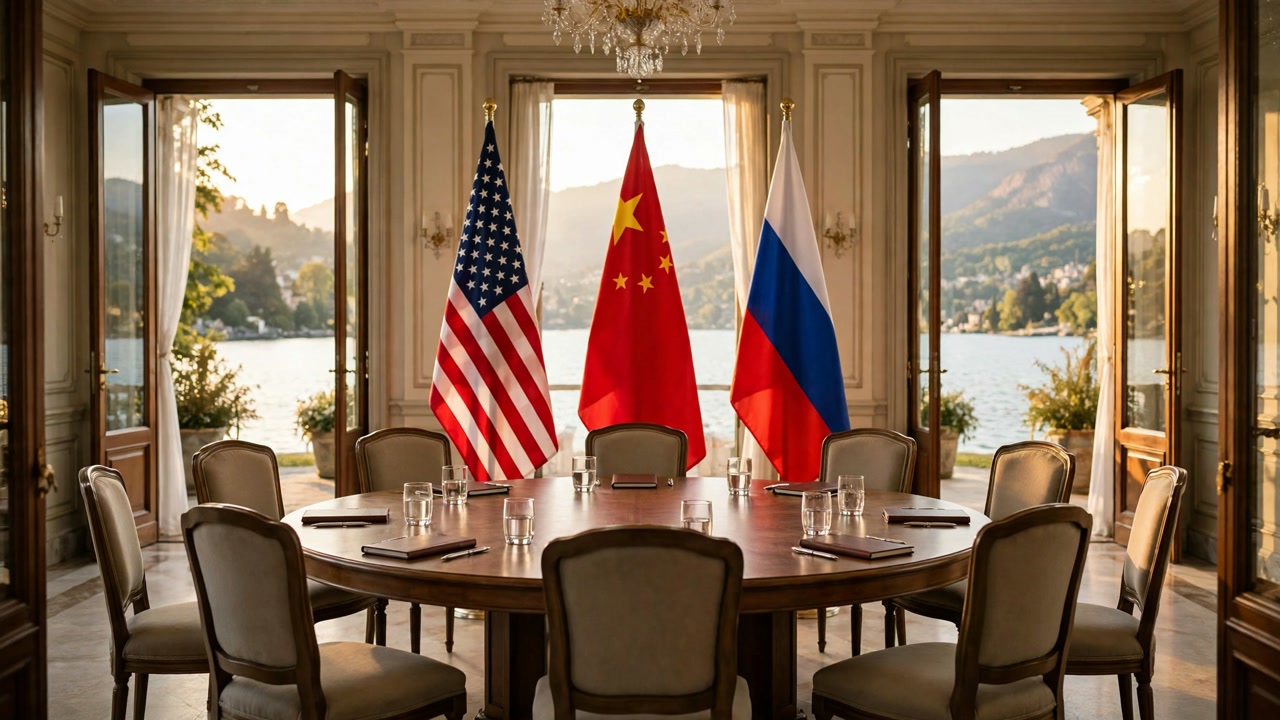
The Trump Xi Putin peace declaration was adopted on Thursday, November 19, 2026, after the first-ever trilateral meeting of the presidents of the United States, China and Russia, held at the lakeside Kylin Villa in Shenzhen. The Trump Xi Putin peace declaration pledges that a nuclear war “cannot be won and must never be fought,” promises stable energy supplies and reform of the United Nations, and declares that the International Criminal Court must not abuse its jurisdiction.
The three leaders — Donald Trump, Xi Jinping and Vladimir Putin — met for about 90 minutes on the sidelines of the Asia-Pacific Economic Cooperation (APEC) summit, in the first meeting of its kind between the leaders of the world’s three largest nuclear powers. The four-point document they released, published by China’s state news agency Xinhua and later by the Kremlin, covered Ukraine, the Middle East and the Korean Peninsula in discussion, though the text itself did not mention Ukraine by name. None of the three presidents made immediate public statements after the meeting, and Trump departed on his flight back to the United States.
The summit was the centerpiece of three days of intense diplomacy in the region, and it has already unsettled smaller countries that fear their interests could be disregarded when the three most powerful leaders in the world sit down together. For Washington, Beijing and Moscow, it was a deliberate display: three governments that disagree on almost everything agreeing, at least on paper, on the rules that should govern their rivalry.
What does the Trump Xi Putin peace declaration actually say?
The Trump Xi Putin peace declaration is a short, four-point document, and its wording matters because each point was negotiated between three governments with very different interests. The first point commits the three countries, as permanent members of the United Nations Security Council, to reform the UN so it can respond more effectively to global challenges and carry out its mission of international peace and security. The second says the three countries plan to increase the production and supply of refined petroleum products for the benefit of all nations, and reaffirms the importance of stable energy flows.
The third point is the most pointed. The three leaders recognized that the principle of state consent and respect for the immunities of state officials are of paramount importance, and agreed that the International Criminal Court and other similar bodies “must not abuse their jurisdiction.” That language matters because an ICC arrest warrant issued in 2023 for Vladimir Putin remains in force, and the declaration reads as a direct challenge to the court’s authority over sitting heads of state.
The fourth point is the one that gives the document its name. The three heads of state reaffirmed that “a nuclear war cannot be won and must never be fought,” and said the three countries will conduct a dialogue on reducing nuclear risks and preventing the proliferation of nuclear weapons. The phrase echoes the joint statement the five recognized nuclear powers issued in 2022, but this time it comes from the three leaders alone, in a document they chose to call a peace declaration.
Why did Trump, Xi and Putin meet in Shenzhen?
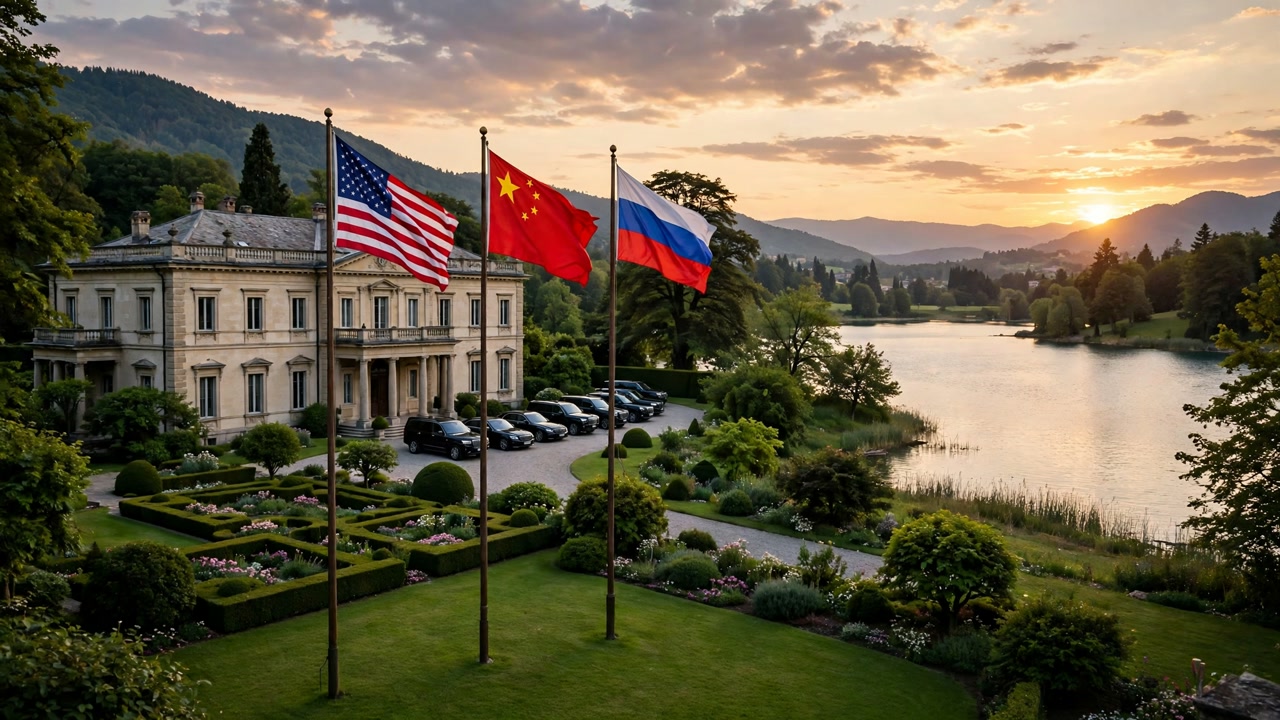
The Trump Xi Putin peace declaration came out of a meeting that was arranged on the sidelines of the APEC forum in Shenzhen, the southern Chinese city hosting this year’s summit. Xi hosted his counterparts at the Kylin Villa, a state residence set among wooded hills beside a lake, and chaired the session after a series of bilateral meetings among the three leaders over the preceding days. Trump had earlier met Xi for their third bilateral meeting of 2026, discussing trade, Ukraine and preventing a nuclear-armed Iran.
The agenda was the set of issues on which the three powers most directly collide: nuclear arms control, the war in Ukraine, the conflict involving Iran, trade, artificial intelligence and China’s access to advanced computer chips. The meeting lasted about 90 minutes and, by the account of the American side, did not yield immediate breakthroughs on the most explosive issues. The declaration is a statement of principles, not a treaty: it sets out no timelines and no mechanisms for carrying out its commitments.
That modesty is part of the point. The three governments have spent the year in open confrontation — over tariffs, over export controls on advanced chips, over the war in Ukraine and over the escalating conflict with Iran, where the United States has been pressing its allies and where Israel’s prime minister has been urging Washington to launch strikes on Iranian nuclear and energy sites. A meeting that produced only a declaration of principles is, by the standards of this year, a de-escalation in itself.
What did the summit not resolve?
The Trump Xi Putin peace declaration does not resolve the war in Ukraine, and Ukraine was not explicitly mentioned in the text. That omission is significant: the war is the largest armed conflict in Europe since 1945, and it is the issue on which the United States and Russia most directly disagree. The leaders discussed Ukraine in the room, according to the statements released afterward, but the declaration contains no commitment on a ceasefire, a settlement or a negotiating process.
It also does not resolve the Iran question. In the days before the summit, Trump said the United States would “see what happens” in the Iran war after January 1, 2027, and warned that if Iran launched a dirty bomb in Washington, the United States would “wipe them out.” The declaration’s language on nuclear risks and proliferation speaks to that confrontation in general terms, but it commits no party to any specific course of action on Iran.
And it does not resolve the trade and technology disputes. The United States has tightened export controls on advanced chips to China, China has restricted exports of critical minerals, and the APEC summit itself produced a separate, limited statement on trade, technology innovation and economic growth. The peace declaration’s pledge on energy supplies — increasing production of refined petroleum products — is the most concrete economic commitment in the document, and even that carries no figures or dates.
Why the Trump Xi Putin peace declaration worries smaller countries
The Trump Xi Putin peace declaration has unnerved smaller countries, and the reason is straightforward: when the leaders of the three largest nuclear powers meet alone and issue a joint statement about the rules of the international system, the countries that were not in the room wonder whose interests were traded away. The declaration’s language on UN reform, on the ICC and on energy supplies was written by the three governments that hold permanent seats on the Security Council and the world’s largest arsenals — not by the countries that depend on the UN and the courts for protection.
The concern is sharpest in Europe and in East Asia. European governments, which have borne the cost of the war in Ukraine, noted that Ukraine went unmentioned in a declaration about peace issued by the three leaders most able to affect the war’s course. In Asia, countries that sit between the United States and China watched a meeting in which their region’s security was discussed without them. And in the Middle East, governments following the Iran confrontation saw a declaration that speaks of nuclear restraint while saying nothing about the strikes and threats of the past two weeks.
The three governments would answer that the declaration is a starting point, not a settlement — a framework for dialogue on nuclear risks and energy stability that others can join. Whether that answer satisfies the countries that were not invited will shape how much weight the document carries in the weeks ahead.
What happens next after the Trump Xi Putin peace declaration?
The immediate next step is the dialogue on nuclear risks that the declaration promises. The three countries said they will talk about reducing nuclear risks and preventing proliferation, but they set no date, no venue and no format. The history of arms control between these three powers suggests that turning a sentence in a declaration into a negotiating process will take months, and that the process will be hostage to every other dispute between them.
The second thing to watch is energy. The pledge to increase production and supply of refined petroleum products is the declaration’s most practical commitment, and oil markets will test it quickly. If the three governments follow through, it could ease prices for importers; if it proves to be rhetoric, the pledge will be forgotten within weeks.
The third is the International Criminal Court. The declaration’s statement that the ICC must not abuse its jurisdiction is a direct challenge to an institution whose warrant for Putin remains outstanding. Whether the three governments take concrete steps to limit the court’s reach — through the UN Security Council, through funding, or through coordinated non-cooperation — will show whether the declaration was a message or a policy.
For now, the Shenzhen summit stands as a piece of history in itself: the first time the three most powerful leaders in the world sat down together, in a lakeside villa in southern China, and put their names to a document called a peace declaration. What that document becomes depends on what they do next.
Key Facts
- The Trump Xi Putin peace declaration was adopted on Thursday, November 19, 2026, after the first-ever trilateral meeting of the US, Chinese and Russian presidents.
- The meeting lasted about 90 minutes at the Kylin Villa in Shenzhen, on the sidelines of the APEC summit; Xi Jinping chaired the session.
- The four-point declaration covers UN reform, increased production and supply of refined petroleum products and stable energy flows, respect for state consent and official immunities with the ICC told not to abuse its jurisdiction, and the pledge that nuclear war “cannot be won and must never be fought.”
- The leaders discussed Ukraine, the Middle East and the Korean Peninsula, but Ukraine was not explicitly mentioned in the declaration text.
- The document was published by China’s Xinhua news agency and later by the Kremlin; no president made an immediate public statement and Trump flew back to the US.
- The declaration sets no timelines or implementation mechanisms; a separate APEC statement covered trade, technology innovation and economic growth.
- An ICC arrest warrant for Vladimir Putin issued in 2023 remains in force.
- The summit followed days of tension over the Iran conflict, US chip export controls and trade disputes between the three countries.
Frequently Asked Questions
What is the Trump Xi Putin peace declaration?
It is a four-point joint statement adopted on November 19, 2026, after the first trilateral meeting of Donald Trump, Xi Jinping and Vladimir Putin in Shenzhen. It pledges UN reform, stable energy supplies, respect for state immunity and limits on the International Criminal Court, and reaffirms that a nuclear war “cannot be won and must never be fought.”
Where and when did the three leaders meet?
They met for about 90 minutes at the Kylin Villa, a state residence in Shenzhen, China, on Thursday, November 19, 2026, on the sidelines of the Asia-Pacific Economic Cooperation (APEC) summit. Xi Jinping hosted and chaired the meeting.
Did the declaration mention Ukraine?
No. The leaders discussed Ukraine in the meeting, according to the statements released afterward, but the declaration text does not mention Ukraine by name and contains no commitment on a ceasefire or settlement.
What did the declaration say about the International Criminal Court?
It said the three leaders agreed that the ICC and similar bodies “must not abuse their jurisdiction,” and that state consent and the immunities of state officials are of paramount importance. An ICC arrest warrant for Vladimir Putin from 2023 remains in force.
Is the peace declaration binding?
No. It is a statement of principles with no timelines, figures or implementation mechanisms. Its practical effect will depend on whether the promised dialogue on nuclear risks and the pledge on energy supplies are followed up.
