
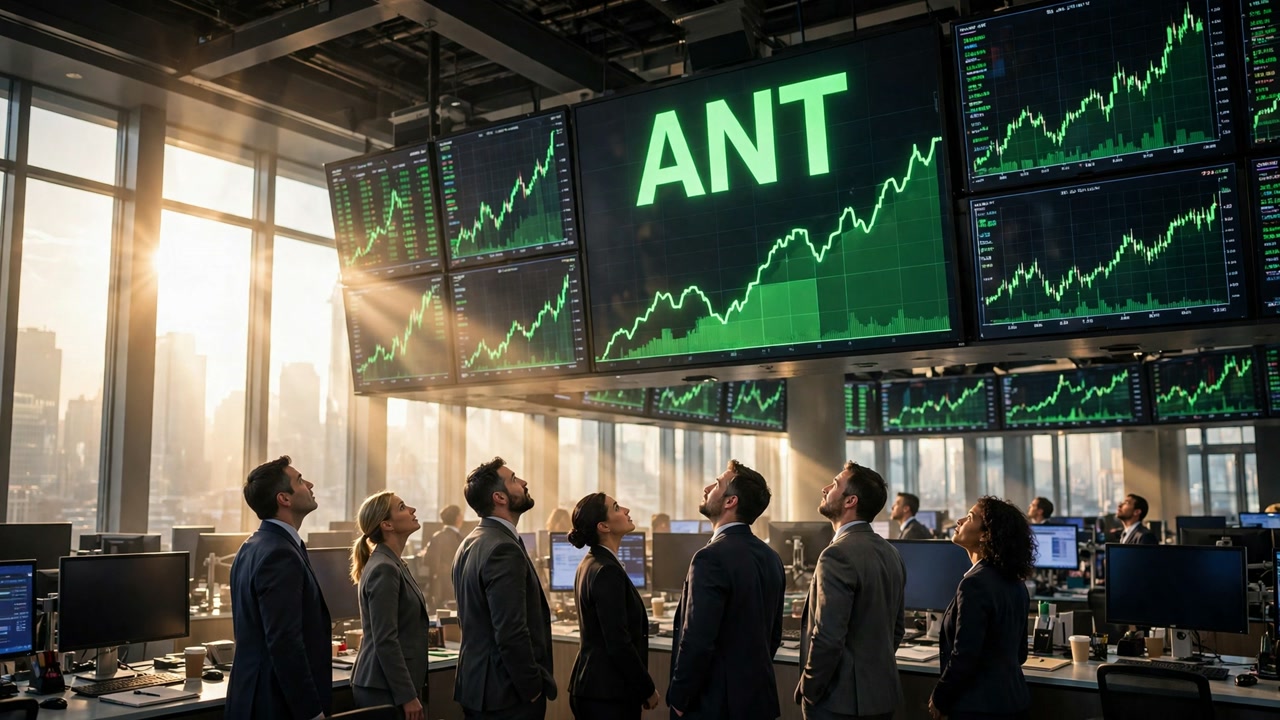
The Anthropic IPO priced at $83 a share on Wednesday, November 18, 2026, raising a record $81.3 billion and valuing the maker of the Claude chatbot at about $1.5 trillion as its shares prepare to start trading on the Nasdaq on Thursday under the ticker ANT. The Anthropic IPO is now the largest stock market debut in history, beating the record set by Elon Musk’s SpaceX in June, after demand was so strong that the company raised both the price and the size of the offering.
Anthropic had first marketed the deal at $70 to $78 a share. The final price of $83 landed 6.4 percent above the top of that range, and the company increased the number of shares on offer from 825 million to 980 million. The total deal reaches $107.3 billion once a separate $26 billion private placement is counted, with strategic investors including Google, Nvidia, AMD, Broadcom, Microsoft, Micron and TSMC buying shares at the IPO price. Goldman Sachs and Morgan Stanley led the underwriting.
The listing makes Anthropic the first major American company built purely on artificial intelligence development to go public, and it arrives at a moment when investors are asking hard questions about whether the AI boom can justify its enormous price tags. The company’s answer, in numbers, is a revenue run rate of about $81 billion a year as of October 31, up $10 billion in a single month. That growth is why the book was reportedly oversubscribed as much as six times over — and why the first day of trading will be watched as a verdict on the whole AI trade.
How big is the Anthropic IPO compared with past listings?
The Anthropic IPO is the biggest public offering ever by the money it raised. The $81.3 billion of gross public proceeds tops the $75 billion record SpaceX set in June 2026, and it dwarfs the classic mega-listings of the past decade. On a fully diluted basis, counting stock options and other securities, the $83 price values Anthropic at about $1.5 trillion. On a simpler, non-diluted basis the value is about $1.1 trillion — still larger than most companies on the Nasdaq.
The scale is striking because Anthropic was valued at about $965 billion as recently as May 2026, when it raised $65 billion in a private funding round. In six months the company’s implied value has risen by more than half a trillion dollars, driven by revenue growth that has few parallels in corporate history. The November 17 filing reported revenue of $33.24 billion for the first nine months of 2026, against $2.55 billion in the same period of 2025 — a thirteen-fold increase. Revenue in the third quarter alone was $16.96 billion, and the company reported $4.59 billion of revenue for the whole of 2025 and just $41 million in 2023.
But the filing also shows the other side of the AI business model. Anthropic recorded a $1.26 billion operating loss in the first nine months of 2026, an improvement from a $5.22 billion operating loss a year earlier, and a reported net loss of about $104 billion, driven largely by non-cash fair-value adjustments to convertible notes and other financing instruments. The company spent nearly $9 billion on computing infrastructure in the first half of 2026 and has disclosed about $900.9 billion in aggregate purchase commitments and leases for future computing capacity. Growth this fast is expensive, and the IPO proceeds are meant to pay for it.
Why did the Anthropic IPO price above its range?
The Anthropic IPO priced above its range because institutional investors wanted far more shares than were available. Demand reportedly reached as much as six times the shares on offer, which gave Anthropic and its underwriters room to lift the price from the $70 to $78 range to $83 and to enlarge the deal from 825 million shares to 980 million. Underwriters also set aside up to 20 percent of the offering for retail investors, an unusually large slice designed to spread ownership beyond institutions.
The revenue numbers explain the enthusiasm. Anthropic’s annualized revenue run rate reached about $81 billion at the end of October, and the number of customers spending at least $100,000 a year has climbed to around 11,900. Claude, the company’s family of AI models, has become one of the two dominant products in the market for AI assistants, alongside OpenAI’s ChatGPT. Investors are betting that the company can convert that position into durable, high-margin software revenue — the kind of business that has historically commanded the richest valuations in the market.
There is also a scarcity argument. Until now, the public markets offered no pure-play way to own a leading AI model developer. OpenAI remains private, and the big listed technology companies mix AI with search, cloud, advertising and devices. Anthropic is the first chance for ordinary investors to buy the AI model business itself, and the pricing suggests they were willing to pay up for it. Nasdaq futures rose nearly 2 percent on Thursday, a move traders linked to expectations of a strong debut and a revival of sentiment around AI stocks.
What does the Anthropic IPO mean for AI stocks?
The Anthropic IPO matters for AI stocks because it sets a public market price on the fastest-growing business in the sector — and that price will be tested from the first minute of trading. If ANT holds above $83, the market is endorsing a valuation of about $1.5 trillion for a company that is still losing money on an operating basis and has committed close to $900 billion to future computing capacity. If it slips, the same numbers become evidence that the AI trade has run too far, too fast.
The result will ripple well beyond Anthropic. Nvidia, which is both a supplier and a private-placement investor in the deal, has seen its own stock whipsawed this month by leadership turmoil and questions about chip exports to China. A strong Anthropic debut would support the case that demand for AI computing is still accelerating. A weak one would feed the opposite argument — that valuations have outrun the economics of building and running these models. Either way, Thursday’s trading will be the first hard data point in that debate.
What should investors watch on Anthropic’s first day?
The first thing to watch is the opening price. The $83 IPO price is only the starting point: once ANT starts trading freely, buyers and sellers will reassess the valuation continuously. A first-day pop would push the fully diluted value above $1.5 trillion; a drop below $83 would put it under. The second thing is volume and volatility. With 980 million shares sold and a large retail allocation, the opening session could be one of the busiest in Nasdaq history.
The third is what Anthropic says about the money. The company raised $81.3 billion in the public offering and another $26 billion in the private placement, and the bulk of it is earmarked for computing infrastructure. Investors will want to know how quickly that capacity turns into revenue, and whether the $81 billion run rate keeps climbing at the pace of recent months. The fourth-quarter numbers, when they arrive, will be the first public test of the growth story that justified the price.
There are governance questions too. Buying Anthropic shares does not give public investors full control of the company, and the filing’s structure — multiple share classes, convertible securities and large equity awards — is part of why the fully diluted valuation of $1.5 trillion sits well above the $1.1 trillion non-diluted figure. Investors who buy ANT are buying into a company whose founders and early backers retain significant power, a common feature of big technology listings but one that matters when a company is spending at this scale.
Why does the Anthropic IPO matter beyond Wall Street?
The Anthropic IPO matters beyond Wall Street because it is a referendum on the economics of artificial intelligence itself. The company behind Claude has grown revenue thirteen-fold in a year, yet it has also committed nearly a trillion dollars to computing capacity it has not yet built. That combination — explosive growth and explosive spending — is the central bet of the AI era, and until today it had never been priced in public.
For the technology industry, the debut sets a benchmark. Every AI startup raising money, every cloud provider buying chips, and every enterprise customer signing a Claude contract will now be measured against a public price. For regulators and policymakers, a $1.5 trillion valuation for an AI developer raises familiar questions about market concentration and the power of a handful of companies over a technology that is spreading into every industry.
And for ordinary savers, the listing is the first chance to own a piece of the company that builds one of the world’s most widely used AI assistants. The question they must answer, starting Thursday, is the same one the institutions answered at $83: whether the fastest revenue growth in modern corporate history is worth a valuation that already assumes it will continue.
Key Facts
- The Anthropic IPO priced at $83 a share on November 18, 2026, above the $70 to $78 marketed range, raising $81.3 billion in the largest IPO on record.
- Anthropic sold 980 million Class A shares, up from 825 million originally planned; the offering closes November 20, subject to customary conditions.
- The $83 price values Anthropic at about $1.5 trillion on a fully diluted basis and about $1.1 trillion on a non-diluted basis; it was valued at about $965 billion in May 2026.
- ANT shares start trading on the Nasdaq on Thursday, November 19, 2026; Goldman Sachs and Morgan Stanley are lead underwriters.
- Total deal size is $107.3 billion including a $26 billion private placement with Google, Nvidia, AMD, Broadcom, Microsoft, Micron and TSMC.
- Anthropic’s annualized revenue run rate reached about $81 billion as of October 31, up $10 billion from September 30; nine-month 2026 revenue was $33.24 billion, versus $2.55 billion a year earlier.
- The company recorded a $1.26 billion operating loss in the first nine months of 2026, improved from $5.22 billion a year earlier, and disclosed about $900.9 billion in compute purchase commitments.
- Demand reportedly reached as much as six times the shares available; up to 20 percent of the offering was reserved for retail investors.
Frequently Asked Questions
What price did the Anthropic IPO set?
The Anthropic IPO priced at $83 per share, about 6.4 percent above the top of its $70 to $78 marketed range and 12.2 percent above the $74 midpoint. The company sold 980 million Class A shares, raising about $81.3 billion.
When does Anthropic start trading?
Anthropic shares start trading on the Nasdaq on Thursday, November 19, 2026, under the ticker symbol ANT. The offering is scheduled to close on November 20, subject to customary conditions.
How much is Anthropic worth after the IPO?
At the $83 IPO price, Anthropic is valued at about $1.5 trillion on a fully diluted basis, which includes stock options and other securities. On a non-diluted basis the valuation is about $1.1 trillion. The company was valued at about $965 billion in a private round in May 2026.
Why is the Anthropic IPO the largest ever?
The $81.3 billion raised beats the previous record of $75 billion set by SpaceX’s debut in June 2026. Including the $26 billion private placement, the total deal size is $107.3 billion.
Is Anthropic profitable?
Not yet on an operating basis. Anthropic reported a $1.26 billion operating loss for the first nine months of 2026, though that improved from a $5.22 billion loss in the same period of 2025. Revenue grew thirteen-fold over the same period, to $33.24 billion.
