
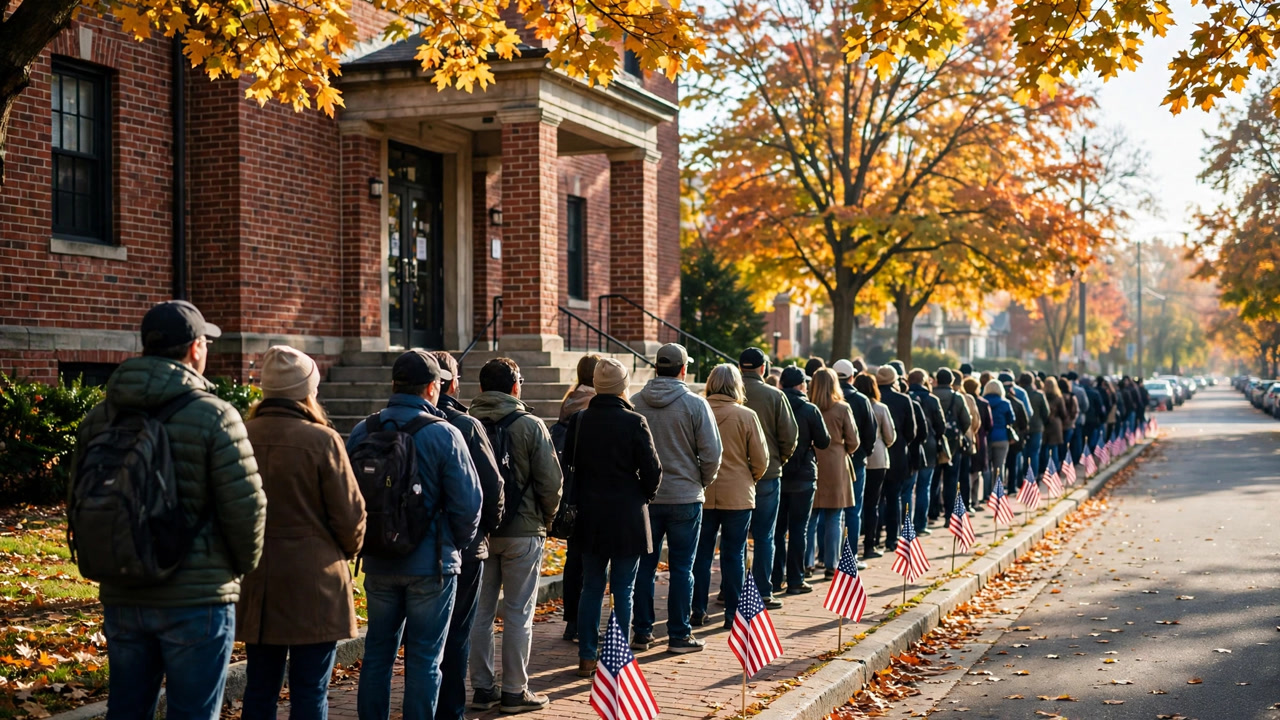
More than 54 million Americans have already cast their ballots ahead of Tuesday’s midterm elections, setting a record for early participation in a midterm cycle and turning Election Day into the final chapter of a vote that is mostly already written. The surge, tracked by the University of Florida’s Elections Research Center and major news outlets, means roughly one in three expected voters had already voted before the campaigns’ final weekend.
The scale matters because these elections decide all 435 seats in the House of Representatives and 35 Senate seats, and with them the balance of power for the final two years of President Donald Trump’s presidency. Polls give Democrats a clear lead in the race for the House, while the Senate remains a genuine contest. But the early numbers come with a warning that every analyst repeats: early votes show who voted, not how they voted — and Election Day itself can still rewrite the story.
How big is the 2026 midterm elections early voting surge?
By the morning of November 1, aggregated counts put early voting past 53.14 million ballots, and later tallies pushed the figure beyond 54 million — a record for a midterm election. The enthusiasm is not evenly spread. In the 27 states that disclose the party registration of early voters, registered Democrats accounted for about 43 to 44 percent of early ballots, against 31 to 32 percent for registered Republicans, a gap of roughly 12 percentage points.
That gap excites Democrats and worries Republicans, but it is a familiar pattern. In recent cycles, Democratic-leaning voters have embraced early and mail voting at higher rates, while Republican-leaning voters have disproportionately waited for Election Day itself. A lead in early ballots is therefore a lead in banked votes, not a lead in the final result — and campaigns on both sides know it.
Why is Texas the fiercest early voting battleground?
Nowhere illustrates the intensity better than Texas. More than 7.7 million Texans voted early in person or by mail before early voting closed on October 30, according to the Texas Secretary of State’s office, making the state one of the largest early-voting pools in the country. Texas is also home to one of the cycle’s most-watched Senate races, where polling has shown Democrats competitive in a state Republicans have long treated as safe ground.
The national picture reinforces that shift. New York Times/Siena battleground polling found Democrats leading in five Republican-held Senate states — Texas, Kansas, Maine, Ohio and Alaska — with Iowa effectively tied. The same polling found Democrats holding a nine-point advantage on the cost of living, the issue voters consistently rank first. An NBC News polling average put the president’s approval rating at 38 percent, with 60 percent disapproving, and found 52 percent of Americans preferring a Democrat-controlled Congress against 44 percent preferring Republican control.
What has the final campaign weekend looked like?
The closing days have been unusually frantic. Trump headlined final rallies in Iowa and Kansas — states where his party would ordinarily expect to win comfortably — and used the Kansas stage to attack Democrats over tax policy, voter identification and border security, accusing them of voting against exemptions on tips, overtime pay and Social Security benefits. He has also dangled the promise of $5,000 payments to every American if his party wins, a pledge that has drawn as much attention as any policy argument of the campaign.
The weekend also exposed a damaging rift in Michigan, a key battleground, where Democratic congresswoman Haley Stevens endorsed the Republican Senate candidate, Mike Rogers, over the Democratic candidate, Abdul El-Sayed. The defection, days before the vote, became one of the most talked-about moments of the final stretch and a symbol of how bitterly contested the Democratic side of the race has become. The midterms have seen about $11 billion spent on advertising, much of it from individual mega-donors, making this one of the most expensive midterm campaigns ever fought.
What could still change on Election Day?
Everything, potentially. Early voting records are set by enthusiasm, and enthusiasm is not evenly distributed across the calendar. If Republican voters turn out in force on Tuesday itself — as they have in past cycles — early leads can narrow or vanish. Analysts caution that it is hard to call the final outcome from early voting alone, and the most honest reading of the data is that Democrats enter Election Day ahead in participation, not ahead in results.
What the record does guarantee is a different kind of election night. With tens of millions of ballots already cast and counted in many states, results in some races could come faster than usual — while in states where mail ballots cannot be processed until Election Day, the wait could be longer. Either way, the 2026 midterms will be remembered as the election Americans voted in early, in record numbers, before the final day had even begun.
Key Facts
- More than 54 million early ballots had been cast before Election Day, a midterm record.
- In 27 states reporting party registration, Democrats made up 43–44% of early voters, Republicans 31–32%.
- Texas alone recorded more than 7.7 million early and mail votes before early voting ended October 30.
- All 435 House seats and 35 Senate seats are on the ballot on November 3, 2026.
- About $11 billion has been spent on midterm advertising, much of it from mega-donors.
- Democrats need a net gain of four seats to take Senate control; 51 seats make a majority including two independents who caucus with the party.
FAQ
When are the 2026 midterm elections?
Election Day is Tuesday, November 3, 2026, but early voting has been running for weeks and more than 54 million ballots were already cast before it.
Does the early voting lead mean Democrats will win?
Not necessarily. Early voting shows who has voted, not how they voted, and Republican-leaning voters have historically turned out in larger numbers on Election Day itself.
Which races are closest?
Polling shows Democrats leading in five Republican-held Senate states — Texas, Kansas, Maine, Ohio and Alaska — with Iowa effectively tied, while the House race leans Democratic overall.
Why is turnout so high?
Analysts point to inflation, tariff policy and fatigue over the Middle East war as drivers, alongside an exceptionally expensive and bitterly fought campaign.
