

All nine people aboard a business jet were killed on Sunday when the aircraft nose-dived into a South Florida neighborhood and erupted into a fireball, in one of the deadliest private aviation accidents in the state in recent years. The Palm Beach Learjet crash happened at about 12:50 p.m. ET near Military Trail and 10th Avenue North, in an unincorporated area between Greenacres and Palm Springs, and left a crater beside a busy roadway.
US Transportation Secretary Sean Duffy confirmed the deaths in a social media post on Sunday, calling the crash a “horrific tragedy.” Remarkably, given where the jet came down, officials said there were no immediate reports of anyone on the ground being killed or injured — though about 600 residents were evacuated from a nearby mobile home community while investigators worked the scene.
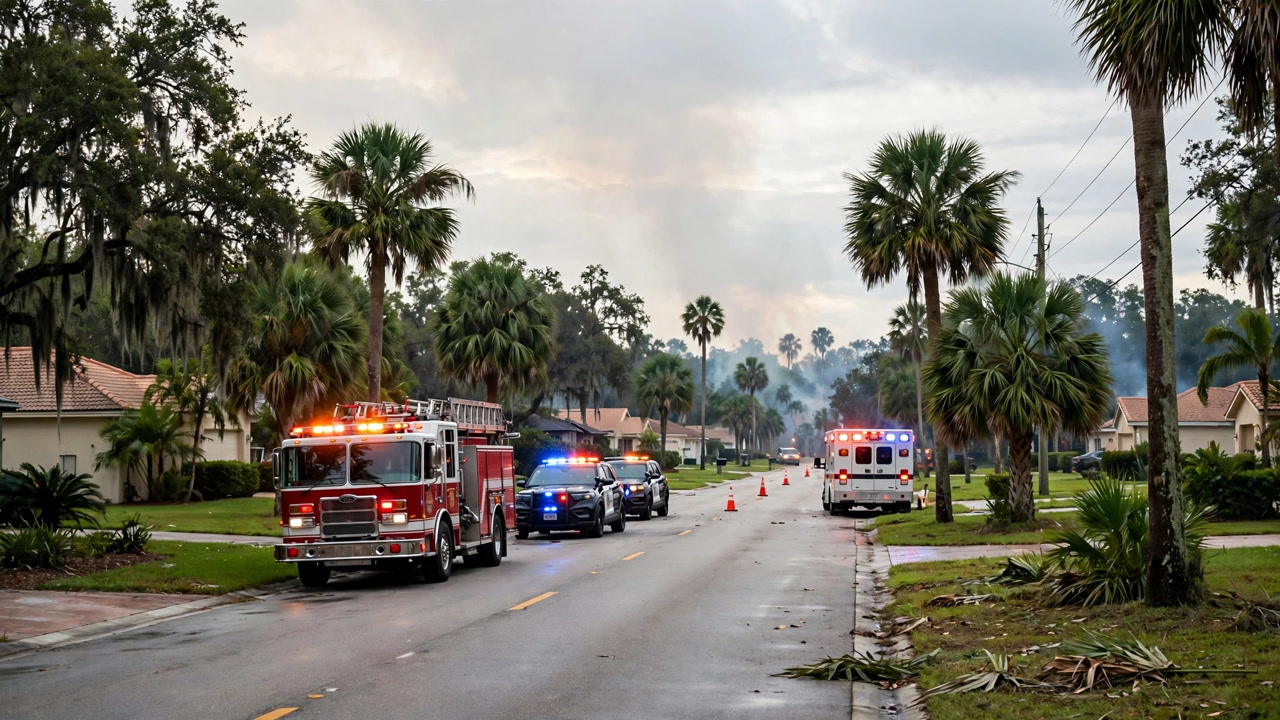
What happened in the Palm Beach Learjet crash?
The aircraft was a Learjet 60, a twin-engine business jet built by Bombardier, that had departed Austin-Bergstrom International Airport in Texas and was bound for North Eleuthera Airport in the Bahamas, according to the Federal Aviation Administration. Its registration was reported as N722BD. Video recorded by people in nearby cars captured the jet plunging steeply toward the ground before striking near the roadway and exploding.
Florida Governor Ron DeSantis, speaking from the scene, described the crash as “cataclysmic” and said the plane “looked like a missile going down, and left a big crater on the side of the road.” Palm Beach County Fire Rescue declared the crash a mass-casualty incident. The jet came down from about 8,000 feet, according to early reports, and appeared to just miss homes before impact — a matter of metres that likely prevented a far worse toll on the ground.
What did the pilots report before the crash?
One of the most important clues to emerge so far is what the pilots told air traffic control in the jet’s final minutes. According to air traffic control recordings cited by CNN, the pilots reported icing, turbulence and precipitation shortly before the aircraft went into its steep descent. Those three words — icing, turbulence, precipitation — now sit at the centre of the investigation, because ice building up on a wing can rob an aircraft of lift with terrifying speed.
Investigators will be careful, however, about drawing conclusions from a single radio exchange. Icing is a known hazard for smaller jets, but the chain of events that turns a weather report into a fatal dive usually involves several factors: the aircraft’s altitude and speed, the severity of the icing, the crew’s responses, and the performance of de-icing systems. The National Transportation Safety Board’s go-team, which was expected at the site on Sunday and Monday morning, will examine the wreckage, the flight data and the cockpit voice recorder if it survived the fireball.
Why were 600 people evacuated?
The evacuation was a precaution driven by geography. The crash site sits beside a mobile home community in the Cresthaven area, and the fireball and burning wreckage posed an immediate risk to nearby homes. Palm Beach County Commissioner Joel Flores said the county’s immediate focus was making sure evacuated residents had shelter and food for the night, with about 600 people needing accommodation.
Roads around the site remained closed as federal investigators took over, and residents were kept away while debris was mapped and the crater examined. Officials have not said when evacuated families will be allowed to return, and that decision will depend on how quickly the wreckage can be cleared and the area declared safe.
What happens next in the investigation?
The FAA has sent a team to support the NTSB investigation, which follows a standard pattern: secure the site, document the wreckage, recover the recorders, interview air traffic controllers and witnesses, and reconstruct the flight’s final minutes. A preliminary report typically takes weeks; a final report, with a probable cause, can take a year or more.
Two questions will dominate the early phase. First, how severe was the icing the pilots reported, and did it exceed what the Learjet 60’s systems could handle? Second, what exactly happened between that final radio call and impact — a question the flight recorders, if recoverable, may answer. Authorities have not released the identities of the nine people on board, and officials have asked for patience while families are notified.
The crash is a reminder of a sobering fact about private aviation: business jets fly millions of safe hours every year, but when something goes wrong at low altitude, crews have almost no time to recover. For the community of Greenacres, a quiet Sunday afternoon became a scene of fire and loss — and for 600 evacuated neighbours, a night spent away from home while investigators pick through what remains.
Key Facts
- A Learjet 60 crashed at about 12:50 p.m. ET on November 1, 2026, near Military Trail and 10th Avenue North in Palm Beach County, Florida.
- All nine people aboard were killed; no deaths or injuries on the ground were immediately reported.
- The jet had departed Austin-Bergstrom International Airport in Texas and was bound for North Eleuthera Airport in the Bahamas.
- The aircraft’s registration was reported as N722BD.
- The pilots reported icing, turbulence and precipitation shortly before the crash, according to air traffic control recordings cited by CNN.
- About 600 residents were evacuated from a nearby mobile home community.
- The FAA and NTSB are investigating; the cause is not yet known.
FAQ
Where exactly did the Palm Beach Learjet crash happen?
Near Military Trail between Cresthaven Boulevard and 10th Avenue North, in an unincorporated area between Greenacres and Palm Springs in Palm Beach County, Florida.
How many people died in the crash?
All nine people aboard the Learjet 60 were killed, US Transportation Secretary Sean Duffy confirmed. No one on the ground was reported killed or injured.
What caused the crash?
The cause is not yet known. Investigators are examining the pilots’ reports of icing, turbulence and precipitation, along with the wreckage and flight recorders.
Where was the jet going?
From Austin-Bergstrom International Airport in Texas to North Eleuthera Airport in the Bahamas.
