
IDFC First Bank ₹590 Crore Fraud: Full Breakdown of the Branch Scam, Market Impact and What It Means for Investor
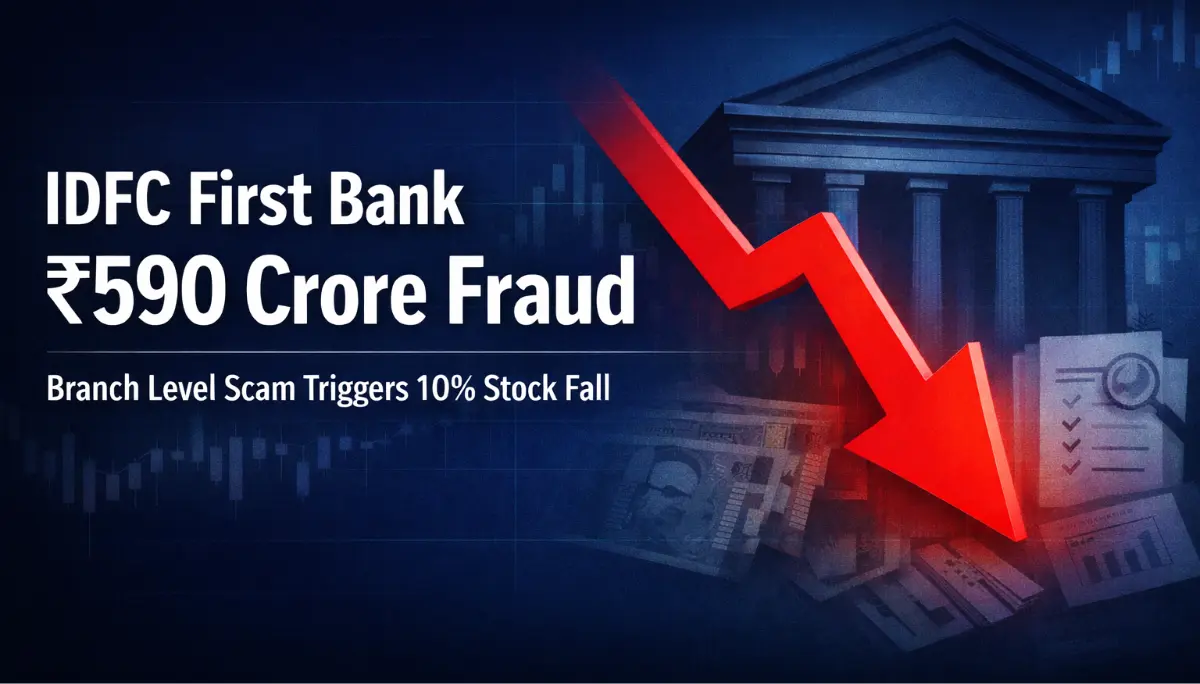
The Indian banking sector was jolted after reports confirmed that IDFC First Bank ₹590 Crore Fraud was detected at a branch level, allegedly involving internal staff and external parties. The disclosure triggered an immediate market reaction, leading to a sharp fall in the bank’s share price and raising questions about internal controls, risk management, and governance standards.
According to reports published by The Economic Times, Upstox, and The Tribune, the fraud involved significant financial irregularities at a Chandigarh branch, with Haryana authorities later taking regulatory action affecting the bank’s empanelment status.
This article breaks down everything in detail:
-
What exactly happened
-
How the fraud was detected
-
Who may be involved
-
Market reaction and stock impact
-
Haryana government action
-
Comparison with past Indian banking frauds
-
What depositors and investors should understand
-
Governance and risk management implications
This is not speculation. This is a structured analysis based on reported developments and financial system principles.
What Happened in the IDFC First Bank ₹590 Crore Fraud Case?
The reported fraud amount stands at approximately ₹590 crore. Early disclosures indicate that:
-
The irregularities were detected internally.
-
Staff members at a Chandigarh branch were allegedly involved.
-
External parties may have colluded in the execution.
-
Regulatory authorities were informed.
-
Internal investigation and corrective action were initiated.
The phrase “connivance of staff and outsiders” used in reporting indicates a potential breakdown of internal control systems, including credit monitoring, transaction oversight, and audit verification.
Frauds of this size typically do not happen overnight. They usually involve:
-
Layered transactions
-
Documentation manipulation
-
Possible misuse of lending facilities
-
Weak internal escalation mechanisms
How Was the Fraud Detected?
Banks typically detect branch level frauds through:
-
Internal audit reviews
-
Concurrent audit checks
-
Risk analytics systems
-
Whistleblower alerts
-
Regulatory inspection
-
Account reconciliation mismatches
In large value fraud cases, detection often happens when:
-
Loan accounts turn irregular unexpectedly
-
Documentation discrepancies surface
-
Recovery processes fail
-
Large exposure accounts cannot be traced properly
The fact that this was disclosed publicly suggests regulatory compliance was followed after discovery.
Immediate Market Reaction
After the news broke, shares of IDFC First Bank reportedly plunged nearly 10 percent intraday.
Why Did the Stock Fall?
Markets react not just to the fraud amount, but to:
-
Perceived governance risk
-
Potential provisioning impact
-
Fear of more hidden irregularities
-
Reputation damage
-
Short term earnings pressure
Even if ₹590 crore is manageable relative to total assets, the trust factor becomes the core issue.
Financial Impact Assessment
To understand the seriousness, we must look at scale.
While ₹590 crore is significant, context matters:
-
Total assets of large private banks run into lakh crores.
-
Net profit margins vary year to year.
-
Provision coverage ratio becomes critical.
If fully provided for, the fraud may:
-
Reduce quarterly profits
-
Impact return on assets
-
Affect investor sentiment
-
Trigger tighter regulatory oversight
However, it does not automatically mean systemic collapse.
Haryana Government Action: Delisting of Two Private Banks
Reports from The Tribune indicated that Haryana delisted two private banks from certain approved panels after the Chandigarh branch incident.
This action typically means:
-
Temporary suspension from government related business
-
Removal from approved vendor or banking partner lists
-
Heightened scrutiny
Such moves are precautionary rather than final judgments.
Internal Controls: Where Could the Breakdown Have Happened?
Large banking frauds usually involve failure in one or more of the following layers:
| Control Layer | Expected Function | Possible Failure |
|---|---|---|
| Branch Manager Oversight | Monitor account operations | Ignored red flags |
| Credit Department | Verify lending proposals | Weak due diligence |
| Internal Audit | Independent review | Gaps in audit coverage |
| Risk Monitoring | Track unusual transactions | Threshold not triggered |
| Compliance Team | Regulatory adherence | Delayed escalation |
Frauds involving staff connivance are particularly complex because insiders understand control loopholes.
Comparison with Past Indian Banking Fraud Cases
Let us compare structurally, not sensationally.
| Case | Amount | Nature | Impact |
|---|---|---|---|
| PNB Nirav Modi Case | ₹13,000+ crore | Trade finance fraud | Systemic shock |
| Yes Bank Crisis | Asset quality collapse | Governance + lending stress | RBI intervention |
| IDFC First Bank ₹590 Crore Fraud | ₹590 crore | Branch level alleged collusion | Market correction |
The key difference here:
This appears to be a branch specific fraud rather than institution wide systemic misreporting.
What This Means for Depositors
Depositors often panic when fraud news surfaces.
Important points:
-
Deposits in Indian banks are regulated by the Reserve Bank of India.
-
Deposit Insurance and Credit Guarantee Corporation covers deposits up to ₹5 lakh.
-
A branch level fraud does not automatically affect savings account holders.
-
Capital adequacy and liquidity ratios matter more than isolated incidents.
There has been no indication of deposit withdrawal restrictions.
What This Means for Investors
Investors must focus on:
-
Provisioning announcement
-
Management commentary
-
Quarterly earnings impact
-
Regulatory observations
-
Future governance strengthening measures
Short term volatility does not equal long term impairment unless deeper issues surface.
Risk Management Lessons
This case reinforces key banking principles:
-
Strong maker checker systems are critical.
-
Automated transaction analytics must evolve.
-
Rotation of sensitive staff roles reduces collusion risk.
-
Surprise audits remain essential.
-
Independent whistleblower systems matter.
Frauds rarely survive strong culture plus strong systems.
Governance Reputation and Trust Factor
Banking is fundamentally about trust.
Even if financial impact is absorbable, reputation damage can:
-
Increase cost of borrowing
-
Reduce institutional investor confidence
-
Slow loan growth
-
Attract stricter regulatory audits
Management response transparency becomes crucial.
Media Coverage and Public Narrative
Coverage from The Economic Times and Upstox highlighted:
-
Staff and outsider involvement
-
Sharp share price reaction
-
Official disclosures
The tone has remained financial rather than sensational, which suggests ongoing investigation rather than confirmed criminal conviction.
Is This a Systemic Banking Risk?
Currently, available information suggests:
-
Isolated branch incident
-
Internal detection
-
Regulatory reporting compliance
-
Market driven correction
There is no indication of:
-
Widespread asset quality misreporting
-
Liquidity crisis
-
RBI emergency intervention
Therefore, this appears contained, pending investigation outcomes.
How Banks Strengthen After Fraud
After incidents like this, banks usually:
-
Tighten credit approval norms
-
Upgrade monitoring software
-
Conduct forensic audits
-
Reevaluate branch authority limits
-
Suspend or terminate involved staff
-
File criminal complaints
Long term, such cases often lead to stronger systems.
Long Term Outlook for IDFC First Bank
The long term trajectory depends on:
-
Speed of investigation closure
-
Recovery potential
-
Governance response quality
-
Capital buffer strength
-
Investor communication clarity
If handled transparently, markets may treat this as a temporary governance lapse rather than structural weakness.
Key Takeaways
-
The IDFC First Bank ₹590 Crore Fraud is serious but appears branch specific.
-
Market reaction was immediate and sharp.
-
Haryana authorities took precautionary action.
-
Depositors are not automatically at risk.
-
Investors should track provisioning and management commentary.
-
Governance strengthening will be critical to rebuild confidence.
Final Analysis
Banking fraud stories generate fear because money represents trust. However, mature financial systems are built with detection, disclosure, and corrective frameworks.
The real question is not whether fraud happened. The real question is:
How quickly was it detected?
How transparently was it disclosed?
How effectively will controls be strengthened?
At this stage, the IDFC First Bank ₹590 Crore Fraud appears to be a serious but contained incident pending deeper investigation findings.
For investors and readers, the smartest approach is not panic, but analysis.
As more official updates emerge, clarity will increase. Until then, the focus should remain on financial fundamentals rather than headlines.


 By
By
 By
By