
When a Tourist Paradise Turns Into a War Zone
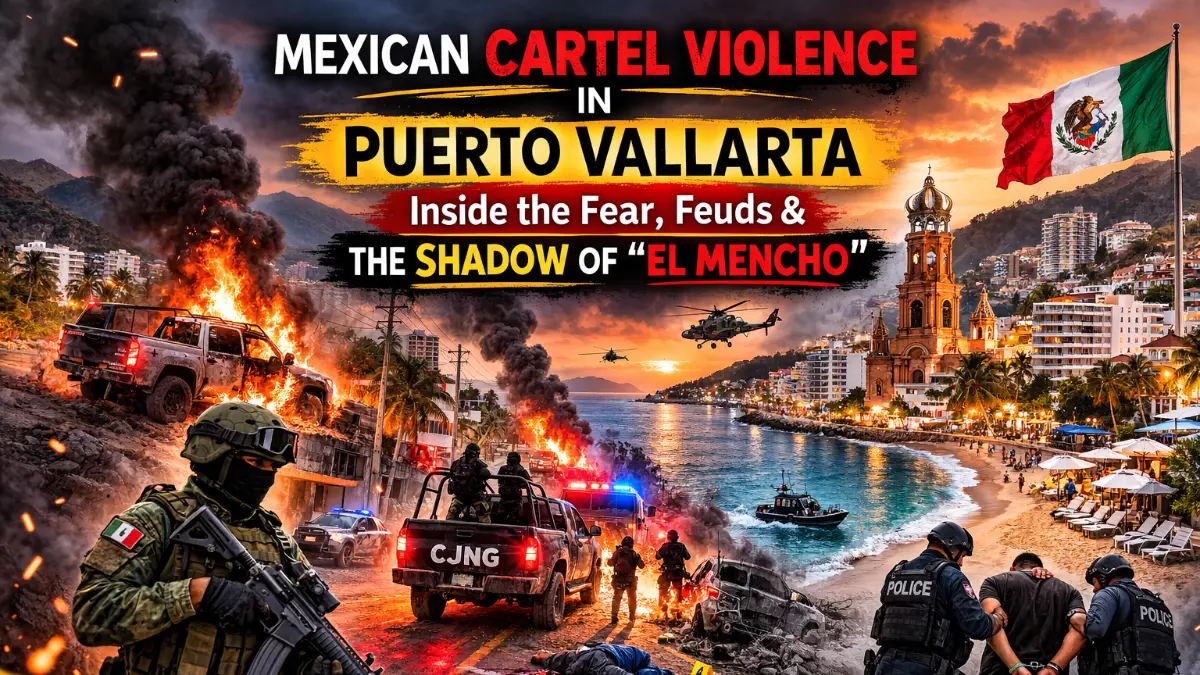
For decades, Puerto Vallarta symbolized sunlit beaches, luxury villas, and carefree tourism. But recent headlines have reshaped global perception. Reports from respected outlets such as BBC and Sky News describe a region shaken by escalating cartel conflict.
The phrase Mexican Cartel Violence in Puerto Vallarta is no longer just a search term—it reflects lived reality for thousands of residents navigating uncertainty, fear, and disruption.
This article dives deep into:
-
The roots of the current cartel feud
-
The influence of Nemesio Oseguera Cervantes, known as El Mencho
-
The role of the Jalisco New Generation Cartel (CJNG)
-
Why Puerto Vallarta became a strategic battleground
-
The broader impact on Mexico
Unlike surface-level summaries, this is a comprehensive, human-centered analysis designed to inform, build trust, and provide clarity—especially valuable for readers seeking credible, in-depth coverage.
1. The Escalation: What’s Happening in Puerto Vallarta?
Recent reporting describes gunfire, burned vehicles, damaged properties, and heavily armed convoys. According to on-the-ground coverage, fear has become a constant undercurrent in neighborhoods once known for nightlife and beach tourism.
The violence stems from:
-
Internal power struggles within cartel networks
-
Territorial disputes
-
Government crackdowns triggering retaliation
-
Fragmentation of criminal alliances
Why Puerto Vallarta?
Puerto Vallarta is more than a tourist hotspot. Strategically, it offers:
-
Coastal access for maritime trafficking routes
-
High-value real estate for money laundering
-
International tourism flows ideal for discreet financial operations
-
Proximity to cartel strongholds in Jalisco
Cartel groups view the region not just as territory—but as infrastructure.
2. The Shadow of El Mencho
At the center of many discussions is El Mencho, the elusive leader of the CJNG. Though reports vary on his exact whereabouts and operational role in recent events, his influence over cartel structure remains undeniable.
Who Is El Mencho?
-
Full Name: Nemesio Oseguera Cervantes
-
Leader of: Jalisco New Generation Cartel
-
Known for: Rapid expansion, paramilitary-style organization
-
Reputation: Highly secretive, strategically adaptive
Even when absent from public view, his organizational framework continues operating through regional commanders and cells.
Why His Influence Matters Now
When leadership structures are threatened—whether through arrests, rival attacks, or internal fractures—cartels often respond with demonstrative force. Violence becomes messaging.
In Puerto Vallarta, observers believe recent escalations may be linked to:
-
Leadership protection measures
-
Internal discipline enforcement
-
Strategic retaliation
While definitive details remain under investigation, the pattern aligns with historical CJNG responses to pressure.
3. Anatomy of a Cartel Feud
Cartel conflicts rarely erupt overnight. They build over time through:
| Trigger Factor | Description | Impact on Violence Level |
|---|---|---|
| Territory Disputes | Competition over trafficking corridors | High |
| Financial Rivalry | Control of money laundering operations | Medium–High |
| Leadership Changes | Arrests or deaths destabilizing hierarchy | High |
| Political Pressure | Military or police crackdowns | High |
| Internal Betrayals | Defections or intelligence leaks | Medium |
The Puerto Vallarta Context
In this case, analysts point to:
-
Strategic port access
-
Luxury villa networks allegedly used for coordination
-
Competition over regional dominance
This combination creates explosive conditions.
4. Media Coverage vs Ground Reality
International outlets have highlighted fear among residents. But beyond headlines, daily life continues—albeit cautiously.
Media Framing Comparison
| Coverage Angle | International Media | Local Perspective |
|---|---|---|
| Tone | Alarmed, urgent | Concerned but pragmatic |
| Focus | Cartel leadership & violence | Safety, economy, tourism |
| Emphasis | Global security implications | Community survival |
| Imagery | Burned cars, armed patrols | Closed shops, quiet streets |
Media attention brings awareness—but it can also intensify tourism anxiety, affecting livelihoods of those not involved in criminal activity.
5. Economic Consequences of Mexican Cartel Violence in Puerto Vallarta
Tourism drives Puerto Vallarta’s economy.
Immediate Effects
-
Hotel cancellations
-
Cruise rerouting
-
Restaurant closures
-
Reduced nightlife activity
Long-Term Risks
-
Investment hesitation
-
Real estate slowdowns
-
International travel advisories
-
Brand damage to Mexico’s tourism image
Yet historically, Puerto Vallarta has shown resilience. Past security incidents led to temporary declines—but recovery followed once stability returned.
6. Why Cartel Violence Persists in Mexico
To understand Puerto Vallarta’s crisis, one must zoom out.
Structural Drivers
-
Drug demand in international markets
-
Weak local institutions in certain regions
-
Corruption networks
-
High youth unemployment
-
Fragmentation of cartels into competing factions
Cartel violence is rarely isolated—it reflects systemic pressure points.
7. The Human Impact: “Fear Is Everywhere”
The most powerful reporting often centers on ordinary voices:
-
Shop owners closing early
-
Parents limiting children’s outdoor activities
-
Taxi drivers avoiding certain neighborhoods
-
Hotel staff concerned about job security
Fear changes behavior long before official statistics reflect a crisis.
Psychological Consequences
-
Heightened anxiety
-
Community mistrust
-
Rumor proliferation via social media
-
Reduced public gatherings
Violence doesn’t just damage property—it reshapes daily life.
8. Government Response: Strategy and Limitations
Mexico’s federal and state authorities typically respond through:
-
Military deployment
-
Road checkpoints
-
Intelligence operations
-
High-profile arrests
Response Comparison Table
| Strategy | Strength | Limitation |
|---|---|---|
| Military Deployment | Rapid control of hotspots | Temporary suppression |
| Leadership Targeting | Weakens command structure | Can trigger violent power struggles |
| Financial Crackdowns | Disrupts funding | Requires deep coordination |
| Community Programs | Long-term stability | Slow results |
The challenge lies in balancing immediate security with sustainable reform.
9. Is Puerto Vallarta Still Safe for Tourists?
Safety assessments vary by location and timing.
Tourist zones often remain more protected due to economic importance. However, perception plays a major role in decision-making.
Risk Comparison
| Area Type | Risk Level | Security Presence |
|---|---|---|
| Major Tourist Districts | Moderate | High |
| Outskirts & Non-Tourist Zones | Higher | Moderate |
| Rural Trafficking Corridors | High | Variable |
Travel decisions should rely on official advisories rather than viral videos.
10. Cartel Evolution: From Smuggling to Corporate-Style Operations
Modern cartels operate more like multinational enterprises than informal gangs.
They manage:
-
Logistics
-
Recruitment
-
Financial accounting
-
Territorial marketing
-
Propaganda
The CJNG in particular became known for rapid territorial expansion and militarized tactics.
This sophistication complicates enforcement efforts.
11. The Villa Narrative: Symbolism and Strategy
Reports describing villas allegedly linked to cartel leadership highlight a key reality: crime networks often embed within affluent communities.
Luxury properties serve multiple purposes:
-
Safe meeting zones
-
Temporary hideouts
-
Financial laundering vehicles
-
Status projection
These spaces blur lines between legitimate wealth and criminal capital.
12. Digital Age Amplification
Social media intensifies fear.
Within minutes:
-
Gunfire videos spread globally
-
Unverified rumors trend
-
Edited clips distort context
While journalism from institutions like the BBC and Sky News attempts verification, online ecosystems can amplify panic.
13. Comparing Cartel Violence Across Regions
| Region | Dominant Group | Violence Pattern |
|---|---|---|
| Jalisco | CJNG | Rapid tactical displays |
| Sinaloa | Multiple factions | Leadership-based conflict |
| Border States | Various | Trafficking route disputes |
| Tourist Hubs | Mixed influence | Strategic containment |
Puerto Vallarta’s situation reflects both strategic containment and symbolic power projection.
14. What Happens Next?
Several scenarios are possible:
-
Short-Term Spike, Rapid Stabilization
-
Extended Low-Level Conflict
-
Leadership Disruption Triggering Fragmentation
-
Strong Federal Containment Effort
Historical patterns suggest cycles rather than permanent escalation.
15. Trust, Reporting, and Responsible Analysis
In an age of sensational headlines, credibility matters.
Responsible coverage should:
-
Avoid exaggeration
-
Distinguish confirmed facts from speculation
-
Provide socioeconomic context
-
Humanize affected communities
For new media platforms and growing sites, depth and nuance build long-term trust far more effectively than dramatic but shallow summaries.
Conclusion: Beyond Headlines
Mexican Cartel Violence in Puerto Vallarta is not a simple story of chaos. It is a complex intersection of power, economics, strategy, and human resilience.
Puerto Vallarta remains a city with vibrant culture, hardworking residents, and global appeal. But it is also navigating a dangerous chapter shaped by cartel rivalry and the lingering influence of figures like El Mencho.
Understanding this moment requires more than alarm—it requires context.
As investigations continue and security responses evolve, one truth remains clear: sustainable stability will depend not just on arrests or military operations, but on deeper structural reform, economic opportunity, and institutional trust.
For readers seeking clarity rather than noise, that context makes all the difference.
 Read More

 By
By