


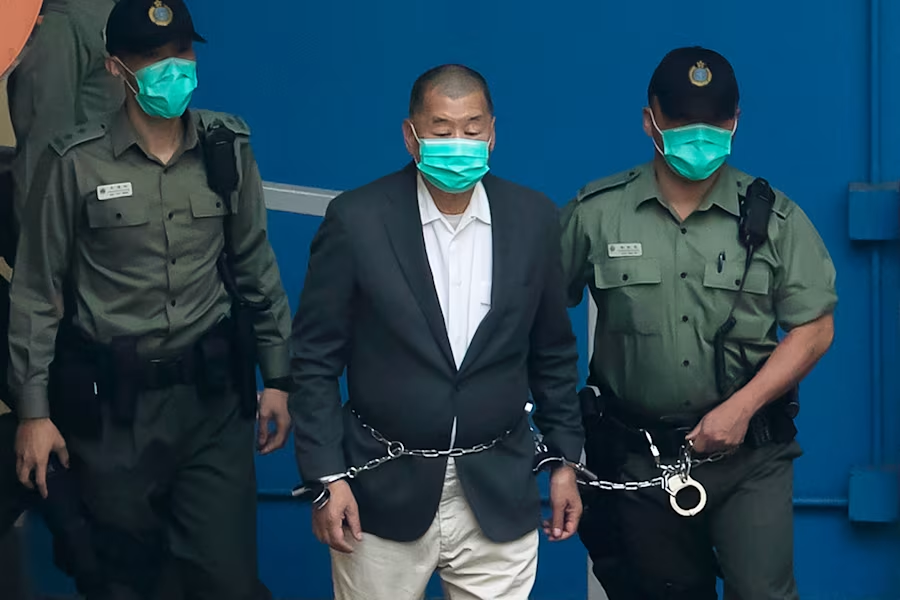
Jimmy Lai Sentenced to 20 Years: Unpacking the Landmark Case Shaking Hong Kong’s Future
In the bustling heart of Hong Kong, where skyscrapers pierce the sky and the hum of commerce never quite fades, a courtroom decision on February 9, 2026, sent ripples across the world. Jimmy Lai, the 78-year-old media tycoon turned pro-democracy icon, was handed a 20-year prison sentence for charges under the city’s controversial national security law. This isn’t just another legal verdict; it’s a flashpoint in the ongoing tug-of-war between Beijing’s grip on the semi-autonomous region and the fading echoes of its once-vibrant freedoms. Lai, founder of the now-defunct Apple Daily newspaper, has long been a thorn in the side of the Chinese government, using his platform to champion democracy and critique authoritarian rule. But to authorities in Hong Kong and mainland China, he was a dangerous instigator, colluding with foreign powers to undermine stability.
I’ve followed stories like this for years, and what strikes me about Lai’s case is how it encapsulates the dramatic shift in Hong Kong since the 2019 protests. Back then, millions took to the streets demanding greater autonomy, only to see Beijing respond with a sweeping law that critics say has silenced dissent overnight. Lai’s sentencing— the harshest yet under this law—raises tough questions: Is this justice, or a calculated move to erase opposition? Let’s break it down step by step, drawing from a wide range of sources to give you a full picture, including perspectives from both sides of the divide.


Who Is Jimmy Lai? From Rags to Riches to Resistance
Jimmy Lai’s life reads like a classic underdog tale with a political twist. Born in Guangdong Province, China, in 1947, he fled to Hong Kong at age 12 during the Great Leap Forward famine, arriving with nothing but determination. He started as a factory worker, taught himself English, and by the 1980s, built a clothing empire with Giordano, a popular retail chain. But the 1989 Tiananmen Square massacre changed everything for him. Horrified by the crackdown, Lai pivoted to media, founding Next Media and launching Apple Daily in 1995—a tabloid-style paper known for its bold, pro-democracy stance and investigative journalism.
Apple Daily wasn’t just a newspaper; it was a megaphone for Hong Kong’s frustrations. During the 2019 protests, sparked by an extradition bill that many feared would erode the city’s autonomy, the paper’s front pages blared support for demonstrators. Lai himself joined marches, met with U.S. officials like Mike Pence, and openly called for international sanctions against China. “I’m not afraid,” he once told reporters. “If I were, I wouldn’t be doing this.” His British citizenship, acquired later in life, added another layer, making him a symbol of Western influence in Beijing’s eyes.
But success came at a cost. Lai faced arrests, his home was firebombed, and Apple Daily’s offices were raided. By 2021, under pressure from the national security law, the paper shuttered, laying off hundreds. Lai has been in custody since December 2020, mostly in solitary confinement, battling health issues like diabetes and heart problems. His son, Sebastien Lai, described the 20-year sentence as “essentially a death sentence,” given his father’s age and condition.
This background isn’t just biography—it’s key to understanding why Lai’s case has drawn such intense scrutiny. From a self-made billionaire to a jailed activist, his journey mirrors Hong Kong’s own evolution from a freewheeling hub to a city under tighter control.
The National Security Law: Beijing’s Tool for Stability or Suppression?
To grasp why Jimmy Lai was sentenced to 20 years, we need to zoom out to the law itself. Imposed by Beijing in June 2020 amid the 2019 unrest, the National Security Law (NSL) criminalizes secession, subversion, terrorism, and collusion with foreign forces. Penalties can reach life imprisonment. Proponents, including Hong Kong Chief Executive John Lee, argue it restored order after months of chaos that paralyzed the city. “The law has safeguarded national security and ensured the long-term prosperity and stability of Hong Kong,” Lee said in a statement welcoming Lai’s sentence.
From China’s perspective, the NSL was necessary to prevent foreign interference. Chinese Foreign Ministry spokesperson Lin Jian defended the verdict, calling Lai a “major planner and participant in anti-China destabilizing activities.” He emphasized that the sentence was “lawful and just,” and urged other countries to respect China’s sovereignty. Sources like the Global Times, a state-backed outlet, portrayed Lai as a “troublemaker” who incited violence and sought U.S. intervention, even allegedly suggesting nuclear strikes—a claim echoed in some pro-Beijing narratives.
Critics, however, see it as a blunt instrument to crush dissent. Human rights groups like Amnesty International called the law “draconian,” pointing out how it has led to over 300 arrests and the closure of civil society organizations. The U.S. State Department labeled it a “tool of repression,” while the UK accused China of breaching the 1984 Sino-British Joint Declaration that promised Hong Kong’s high degree of autonomy until 2047.
In Lai’s case, the NSL’s broad definitions played a central role. Charges of “collusion” stemmed from his meetings with foreign officials and calls for sanctions, while “sedition” targeted Apple Daily’s articles deemed to incite hatred against the government.


The Trial: A Marathon of Evidence and Controversy
Lai’s trial began in December 2023 and dragged on for over a year, with more than 100 hearing days. Unlike typical Hong Kong trials, there was no jury—judges were hand-picked by the government, a provision under the NSL for security cases. Prosecutors painted Lai as the “mastermind” behind conspiracies to lobby foreign governments for sanctions and to publish seditious content through Apple Daily.
Key evidence included Lai’s interviews where he urged the U.S. to “stand with Hong Kong,” meetings with Trump administration figures, and over 160 articles from Apple Daily labeled as seditious. One prosecutor argued these pieces “poisoned the minds of citizens” and fueled the 2019 protests. Defense lawyers countered that Lai was exercising free speech, protected under Hong Kong’s Basic Law, and that his actions were peaceful advocacy, not collusion.
In December 2025, Lai was convicted on two counts of conspiracy to collude with foreign forces and one of conspiracy to publish seditious materials. Six former Apple Daily executives and two activists, who pleaded guilty to lesser charges, received sentences ranging from 6 years and 3 months to 10 years. The judges justified the 20-year term by classifying the offenses as “grave,” noting Lai’s central role and lack of remorse.
What made the trial controversial? Witnesses included former staff who testified under immunity, raising questions about coercion. International observers were limited, and Lai’s health deteriorated during proceedings. Rights groups like Reporters Without Borders decried it as a “sham,” arguing it criminalized journalism.
From a legal standpoint, the case sets precedents. Sedition laws, dormant for decades, were revived, and “collusion” now encompasses lobbying abroad— a chilling effect on activists.
The Sentence: Details and Immediate Fallout
On February 9, 2026, three judges delivered the verdict: 20 years for Lai, with two years overlapping his existing terms for fraud and unauthorized assembly, meaning an additional 18 years behind bars. At 78, this could indeed be a life sentence, as his earliest release (with good behavior) would be in 2044, when he’d be 96.
Co-defendants fared better but still harshly: Former Apple Daily publisher Cheung Kim-hung got 10 years, while others received lighter terms after guilty pleas. The court cited mitigation for those who cooperated but emphasized the “serious and grave criminal conduct” overall.
The fallout was swift. Lai’s family expressed devastation, with his son warning of his father’s declining health in solitary confinement. Ex-employees reportedly “broke down in tears” watching the sentencing.
International Reactions: Outrage and Calls for Action
The world didn’t stay silent. UK Foreign Secretary Yvette Cooper called the sentence “tantamount to a life sentence,” demanding Lai’s release and pledging to “rapidly engage” with China. The U.S. condemned it as a “travesty,” with Secretary of State Antony Blinken urging Beijing to restore freedoms. Taiwan, often at odds with China, denounced the “harsh” penalty.
Media outlets echoed this. The New York Times labeled it a “new era of media peril,” while The Guardian quoted Lai’s family saying he’d “die a martyr.” Rights groups like Human Rights Watch called for sanctions on the judges.
On social media, reactions varied. Some users, like @mayank5885 on X, saw it as punishment for “refusing to stay quiet,” while pro-China accounts celebrated, with @rphkg posting “GREAT DAY FOR HONG KONG!”
Chinese and Hong Kong Government Perspective: Defending the Verdict
Contrastingly, Beijing backed the decision fully. The Chinese Foreign Ministry’s Lin Jian stated Lai “deserved to be severely punished,” highlighting his role in “anti-China, destabilizing activities.” Hong Kong’s government echoed this, with Chief Executive Lee praising the court for upholding the rule of law.
State media like CGTN and Global Times framed Lai as a foreign agent, citing his calls for U.S. intervention and alleged ties to the NED (National Endowment for Democracy). They argued the sentence protects Hong Kong from chaos, pointing to the 2019 protests as evidence of Lai’s harmful influence.
This divide underscores media bias: Western sources focus on freedom erosion, while Chinese ones emphasize security.
Comparisons: How Does Lai’s Case Stack Up?
To put this in context, let’s compare with other NSL cases.
| Case | Defendant | Charges | Sentence | Key Differences |
|---|---|---|---|---|
| Jimmy Lai (2026) | Jimmy Lai | Collusion with foreign forces, sedition | 20 years | Harshest NSL sentence; media involvement; international meetings |
| Tong Ying-kit (2021) | Activist | Terrorism, secession | 9 years | First NSL conviction; involved motorcycle incident during protest |
| Ma Chun-man (2021) | “Captain America 2.0” | Inciting secession | 5 years 9 months | Social media posts; lighter due to no violence |
| Stand News Editors (2024) | Journalists | Sedition | 21 months (one), community service (one) | Media-related; shorter terms after guilty pleas |
| 47 Democrats (2024) | Opposition figures | Subversion | Up to 10 years | Mass trial; election-related “conspiracy” |
Lai’s 20 years dwarfs others, reflecting his high profile and the “grave” classification. Compared to pre-NSL sedition cases (last in 1967, with fines), it’s a stark escalation.
Sub-comparison: Western vs. Chinese Sentences for Similar Offenses
In the U.S., “seditious conspiracy” (e.g., January 6 rioters) carries up to 20 years, but often less with pleas. China’s security laws are harsher, with life terms common for “endangering state security.” Hong Kong’s hybrid system blends common law with Beijing’s influence, making Lai’s case a hybrid outlier.


Implications for Press Freedom and Hong Kong’s Autonomy
This verdict could spell the end for independent journalism in Hong Kong. Apple Daily’s closure was a harbinger; now, self-censorship is rife. The Committee to Protect Journalists ranks Hong Kong low on press freedom, down from its pre-2020 highs.
For autonomy, it signals Beijing’s dominance. The “one country, two systems” promise feels strained, with more laws like Article 23 looming. Economically, foreign businesses worry about legal risks, potentially accelerating talent exodus.
Yet, from China’s view, stability fosters growth. Hong Kong’s stock market has rebounded post-2019, and tourism is up.
Socially, the case polarizes. Pro-democracy groups fundraise abroad, while locals adapt to the new normal.
Timeline of Key Events in Jimmy Lai’s Saga
| Date | Event |
|---|---|
| 1947 | Jimmy Lai born in China |
| 1959 | Flees to Hong Kong |
| 1989 | Tiananmen inspires activism |
| 1995 | Launches Apple Daily |
| 2019 | Joins protests, meets U.S. officials |
| June 2020 | NSL imposed |
| Dec 2020 | Lai arrested |
| June 2021 | Apple Daily shuts |
| Dec 2023 | Trial begins |
| Dec 2025 | Convicted |
| Feb 9, 2026 | Sentenced to 20 years |
This timeline shows the rapid descent from activist to convict.


A Balanced Analysis: Biases, Realities, and the Road Ahead
Let’s be real: Coverage of Jimmy Lai sentenced to 20 years is biased on all sides. Western media, like CNN and BBC, emphasize human rights, often overlooking China’s security concerns post-2019 violence. Chinese sources dismiss Lai as a traitor, ignoring his contributions to Hong Kong’s economy and free press.
The truth? Lai’s actions—lobbying for sanctions—crossed lines for Beijing, but in democracies, that’s advocacy. The sentence feels disproportionate, yet the NSL is law. For a new site like ours, building trust means presenting facts without spin: This case highlights global tensions, from U.S.-China rivalry to the erosion of colonial legacies.
Looking ahead, appeals are possible, but unlikely to succeed. International pressure might lead to early release, but with U.S. elections looming, geopolitics could harden stances.
In the end, Jimmy Lai’s story isn’t over. It’s a reminder that in places like Hong Kong, the fight for ideas can cost everything. Whether you see him as hero or agitator, his 20-year sentence marks a pivotal moment—one we’ll be discussing for years.
Frequently Asked Questions (FAQ)
Why was Jimmy Lai sentenced to 20 years in prison?
Jimmy Lai was sentenced to 20 years under Hong Kong’s National Security Law after being convicted of conspiracy to collude with foreign forces and conspiracy to publish seditious materials. The court classified the offenses as “grave,” citing his role as a central figure in the case.
What is Hong Kong’s National Security Law?
Hong Kong’s National Security Law, imposed by Beijing in June 2020, criminalizes acts of secession, subversion, terrorism, and collusion with foreign forces. The law allows for severe penalties, including long prison sentences and life imprisonment.
Why is Jimmy Lai’s case considered significant internationally?
Jimmy Lai’s case has drawn global attention because he is a high-profile media figure and pro-democracy advocate. International governments, press freedom organizations, and human rights groups view the verdict as a major test of judicial independence and press freedom in Hong Kong.
How did Apple Daily factor into the trial?
Prosecutors argued that articles published by Apple Daily promoted hostility toward the Hong Kong and Chinese governments. The publication’s editorial stance was cited as evidence supporting charges of sedition and collusion.
What has been the international reaction to Jimmy Lai’s sentence?
Several Western governments, including the United States and the United Kingdom, criticized the sentence, calling it disproportionate. Human rights groups described it as a serious blow to press freedom, while Chinese authorities defended the ruling as lawful and necessary for national security.
What is the Chinese and Hong Kong government’s position on the verdict?
Chinese and Hong Kong officials maintain that the trial followed the rule of law and that Jimmy Lai’s actions threatened national security. Authorities argue the sentence demonstrates that the law applies equally to all individuals.
Does Jimmy Lai’s sentence affect press freedom in Hong Kong?
Media organizations and advocacy groups warn that the verdict may increase self-censorship and further restrict independent journalism in Hong Kong. Supporters of the law argue it has restored stability after the 2019 protests.
Can Jimmy Lai appeal the 20-year sentence?
Jimmy Lai is legally allowed to appeal the ruling, though legal experts note that successful appeals under the National Security Law have been rare.