
Introduction: A Sudden Shift in Global Oil Markets
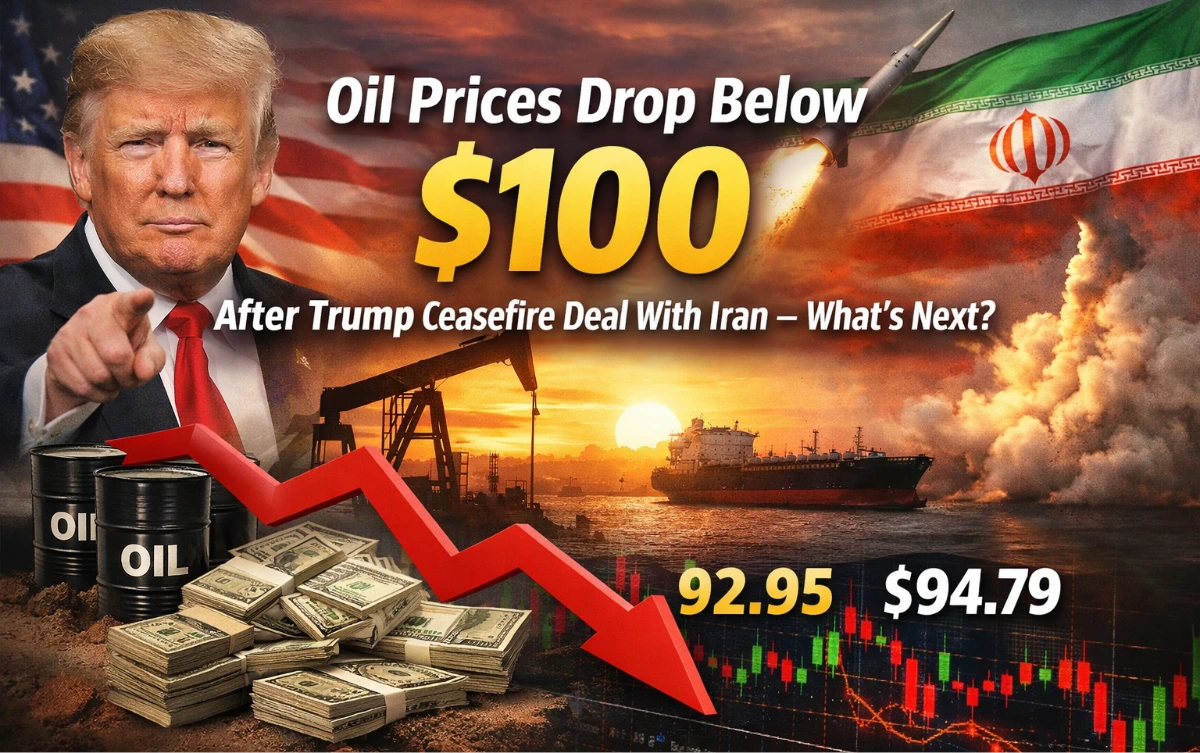
In a dramatic turn of events, global oil prices plunged below the $100 mark after Donald Trump announced a two-week ceasefire agreement with Iran, tied to the reopening of the strategically vital Strait of Hormuz.
The announcement sent shockwaves across financial markets, energy sectors, and geopolitical circles. Within hours, crude benchmarks saw one of their steepest declines in recent months—highlighting just how sensitive global oil flows are to geopolitical stability.
But is this relief temporary—or the beginning of a larger shift?
Let’s break it down in detail.
📉 Oil Prices Crash: Key Market Data
| Benchmark | Price Before | Price After | Change | % Drop |
|---|---|---|---|---|
| Brent Crude | $109.27 | $92.95 | -$16.32 | -14.9% |
| WTI Crude | $112.95 | $94.79 | -$18.16 | -16.1% |
What This Means:
- One of the sharpest single-day declines in oil prices this year
- Market reacting to reduced supply risk
- Traders unwinding “war premium” built over past weeks
Why Oil Prices Dropped Below $100
1. Ceasefire Agreement Changes Everything
The biggest trigger behind the price crash is the ceasefire deal between the U.S. and Iran.
According to Trump:
- Iran proposed a 10-point peace framework
- Both sides agreed to halt attacks temporarily
- The ceasefire depends on safe oil transit
This instantly reduced fears of:
- Supply disruption
- Military escalation
- Infrastructure attacks
2. Strait of Hormuz Reopening
The Strait of Hormuz handles:
- 20% of global oil supply
- Key exports from Saudi Arabia, UAE, Iraq, Kuwait
When tensions escalated:
- Shipping risks surged
- Insurance costs increased
- Oil prices spiked above $100
Now, with reopening:
- Supply flows normalize
- Risk premium collapses
- Traders turn bearish
3. Market Psychology Shift
Oil markets don’t just react to reality—they react to expectations.
Before ceasefire:
- Fear-driven buying
- Speculative spikes
- War-driven panic
After ceasefire:
- Profit booking
- Risk-off sentiment
- Cooling of volatility
🌍 Geopolitical Context: What Led to This Situation?
Timeline of Events
| Phase | Event |
|---|---|
| Early March | Conflict escalates between US-Israel alliance and Iran |
| Mid March | Oil prices surge over 50% (historic rally) |
| Late March | Threat to close Strait of Hormuz |
| April | Trump issues ultimatum |
| April 8 | Ceasefire announced |
The War Premium Explained
The “geopolitical premium” in oil refers to:
- Extra price added due to risk
- Fear of disruption in supply
- Market uncertainty
Even now, analysts say:
This premium may not disappear fully.
⚠️ Why This Drop May Not Last
Despite the sharp decline, experts warn:
1. Temporary Ceasefire Only
- Agreement is for just two weeks
- No long-term treaty yet
- Talks still ongoing
2. Iran’s Strategic Leverage
Iran has demonstrated:
- Ability to disrupt oil routes
- Influence over regional tensions
- Strategic control over shipping lanes
This means:
👉 Future threats could return quickly
3. Continued Military Activity
Reports suggest:
- Missile launches detected in Gulf regions
- Drone threats remain
- Civilian warnings issued
👉 The situation is still fragile
📊 Expert Opinions & Market Reactions
Analyst Insights
| Expert | View |
|---|---|
| ING Strategists | Volatility will continue during negotiations |
| MST Marquee | Future threats to Hormuz likely |
| Commonwealth Bank | Geopolitical premium may stay long-term |
| IG Markets | “Good start, but uncertain outcome” |
Key Takeaways from Experts
- Oil may stay volatile
- Prices could bounce back quickly
- Long-term peace is still unclear
🔍 What Happens If Talks Fail?
Let’s explore worst-case scenarios:
Scenario 1: Ceasefire Breaks
- Oil jumps back above $110
- Panic buying resumes
- Shipping disruption returns
Scenario 2: Strait Closes Again
- Global supply shock
- Prices could hit $150+
- Inflation spikes globally
Scenario 3: Full-Scale Conflict
- Historic oil rally
- Economic slowdown
- Market crash risk
📈 What Happens If Peace Holds?
Best-Case Scenario
If negotiations succeed:
- Oil stabilizes between $80–$95
- Inflation eases globally
- Energy markets normalize
- Shipping costs drop
🧠 Strategic Insight for Investors
Short-Term Strategy
- Expect high volatility
- Avoid over-leveraged positions
- Watch geopolitical headlines
Long-Term Strategy
- Energy stocks still attractive
- Diversify into renewables
- Monitor Middle East risks
🌐 Impact on Global Economy
Positive Effects
- Lower fuel prices
- Reduced inflation pressure
- Improved trade flow
Negative Risks
- Uncertainty still high
- Investor confidence fragile
- Supply chain risks remain
🇮🇳 Impact on India
For India, this is crucial:
Benefits
- Cheaper crude imports
- Lower petrol/diesel prices
- Reduced fiscal pressure
Risks
- Currency volatility
- Import dependency still high
- Future price shocks possible
🔮 Future Outlook: What Should You Watch?
Key Indicators
- Status of ceasefire talks
- Movement in Strait of Hormuz
- US-Iran diplomatic signals
- Oil inventory data
📊 Comparison: Before vs After Ceasefire
| Factor | Before | After |
|---|---|---|
| Oil Prices | Above $100 | Below $100 |
| Risk Level | Extreme | Moderate |
| Shipping | Disrupted | Reopening |
| Market Sentiment | Panic | Relief |
| Volatility | High | Still High |
🧾 Final Analysis
The drop in oil prices below $100 is a classic example of how geopolitics drives markets.
The ceasefire between the U.S. and Iran—led by Donald Trump—has temporarily cooled fears, but the situation remains highly fluid.
The reopening of the Strait of Hormuz is the biggest positive development—but also the biggest risk point.
🧩 Conclusion: Relief Rally or Temporary Illusion?
This price drop is not just about oil—it’s about global stability, diplomacy, and risk perception.
👉 If peace holds, markets stabilize
👉 If tensions return, prices could explode again
Right now, the world is watching one thing:
Will this ceasefire turn into lasting peace—or just a pause before the next crisis?


 By
By