
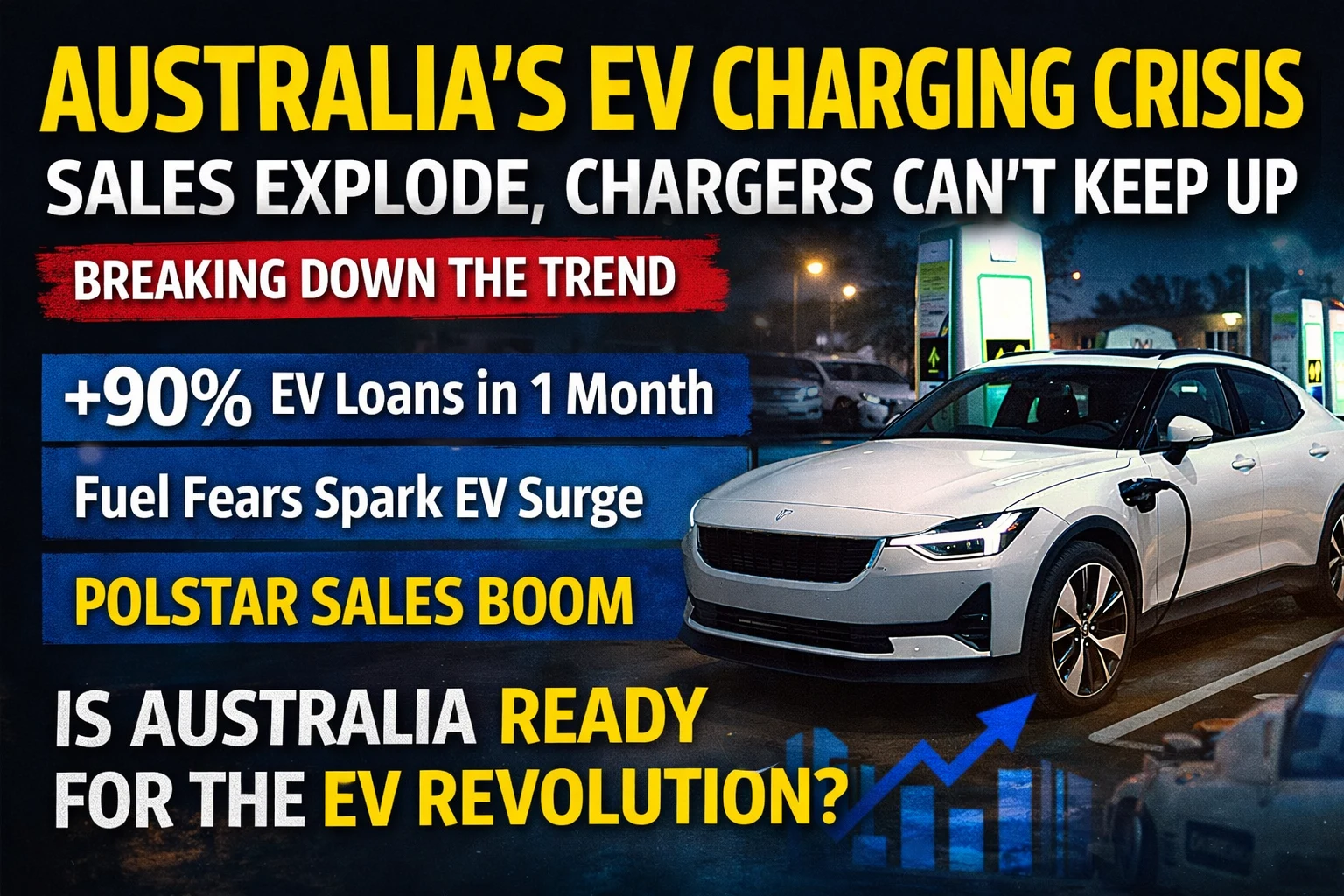

Australia EV Charging Crisis: Sales Boom, Infrastructure Struggle & What It Means for the Future
Introduction: A Boom That’s Turning Into a Bottleneck
Something unusual is happening in Australia’s automotive market.
Electric vehicle (EV) sales are exploding — doubling in some regions — yet drivers are facing a frustrating reality:
finding a place to charge is becoming harder, not easier.
The phrase “Australian EV charging crisis” is now trending across major platforms, and for good reason.
- EV demand is surging
- Fuel prices are volatile
- Infrastructure is lagging behind
This is no longer just a tech or environmental story — it’s a national mobility challenge.
What’s Driving the EV Boom in Australia?
The surge in EV adoption isn’t random. It’s being fueled by multiple forces working at once.
1. Rising Fuel Security Concerns
Australia’s reliance on imported fuel has made energy security a major issue. Consumers are actively looking for alternatives.
2. Financial Incentives & Loans
Reports show a sharp increase in EV-related loans — in some cases up to 90% in a single month.
3. Falling EV Costs
Brands like Polestar are expanding their presence, making EVs more accessible.
EV Sales vs Charging Infrastructure: A Growing Gap
Let’s break this down with a simple comparison:
| Factor | Current Situation |
|---|---|
| EV Sales Growth | Rapid (doubling year-on-year) |
| Charging Stations | Slow expansion |
| Urban Coverage | Moderate |
| Rural Coverage | Poor |
| Charging Wait Time | Increasing |
👉 Key Insight: Demand is outpacing infrastructure — and that’s the core of the crisis.
What Exactly Is the “Australian EV Charging Crisis”?
The term refers to a combination of issues:
1. Insufficient Charging Stations
Many regions simply don’t have enough chargers.
2. Uneven Distribution
Urban areas are better served, while rural zones are left behind.
3. Long Wait Times
As EV numbers grow, queues at charging stations are becoming common.
4. Slow Charging Speeds
Not all stations offer fast charging, leading to delays.
Case Study: The Rise of Polestar
One standout story in this surge is Polestar.
Why Polestar Is Gaining Momentum
- Competitive pricing
- Premium design
- Strong marketing in Australia
Impact on the Crisis
Ironically, increased EV adoption from brands like Polestar is accelerating the infrastructure strain.
Fuel Crisis vs EV Adoption: A Direct Link
The connection is simple:
| Fuel Market Issue | EV Impact |
|---|---|
| Rising petrol prices | More EV demand |
| Supply uncertainty | Shift to electric |
| Global tensions | Faster adoption |
👉 The more unstable fuel becomes, the faster people switch to EVs — even if infrastructure isn’t ready.
Urban vs Rural: The Hidden Divide
Urban Areas
- More charging stations
- Faster adoption
- Better government support
Rural Areas
- Limited or no charging infrastructure
- Range anxiety remains high
- Slower EV adoption
👉 This divide could shape the future of transportation inequality in Australia.
Comparison: Australia vs Other EV Markets
| Country | EV Adoption | Charging Network | Overall Readiness |
|---|---|---|---|
| Norway | Very High | Excellent | Fully prepared |
| China | Extremely High | Extensive | Highly advanced |
| USA | High | Growing | Moderate |
| Australia | Rising fast | Limited | Struggling |
👉 Australia is ahead in demand but behind in execution.
Why Infrastructure Isn’t Keeping Up
Several factors are slowing down progress:
1. High Installation Costs
Building fast chargers requires significant investment.
2. Grid Limitations
Power supply infrastructure needs upgrades.
3. Policy Delays
Government initiatives are improving but still lagging.
4. Private Sector Hesitation
Companies are cautious due to uncertain ROI.
Real-World Challenges EV Owners Face
Common Problems
- Waiting 30–60 minutes for a charger
- Traveling long distances for charging access
- Apps showing inaccurate charger availability
- Broken or slow charging units
👉 These issues reduce consumer confidence — even as interest grows.
Loans for EVs: A Hidden Growth Driver
Financial institutions are playing a major role.
Key Trend
EV loans have surged dramatically — nearly doubling in a short time.
Why This Matters
- Makes EVs accessible to more buyers
- Accelerates adoption
- Increases pressure on infrastructure
Environmental Impact: Still a Positive Story
Despite the crisis, EV growth remains beneficial.
Benefits
- Lower emissions
- Reduced dependence on fossil fuels
- Cleaner urban air
👉 The challenge is not EVs — it’s supporting them properly.
Government Response: What’s Being Done?
Authorities are taking steps, but progress is gradual.
Current Initiatives
- Funding for charging networks
- Incentives for EV buyers
- Partnerships with private companies
What’s Missing
- Faster execution
- Nationwide consistency
- Rural-focused planning
Future Outlook: What Happens Next?
There are three possible scenarios:
1. Rapid Expansion
Infrastructure catches up → crisis resolved
2. Continued Lag
EV growth outpaces charging → worsening problem
3. Balanced Growth
Gradual improvements stabilize the market
👉 Most experts believe Australia will move toward balanced growth, but not without short-term pain.
Expert Insight: Is This a Crisis or Growing Pain?
Many analysts argue:
“This isn’t a failure — it’s a sign of success happening too quickly.”
In other words, demand is strong — systems just need time to adapt.
Conclusion: A Turning Point for Australia’s EV Future
The Australian EV charging crisis is not just a problem — it’s a turning point.
It highlights a simple truth:
👉 Demand alone isn’t enough.
👉 Infrastructure must evolve just as fast.
Australia is at a crossroads:
- Continue scaling EV adoption
- Or risk slowing momentum due to poor support
The next 12–24 months will decide whether this becomes a temporary bottleneck or a long-term barrier.
Quick FAQ
What is the Australian EV charging crisis?
A shortage of charging infrastructure compared to rising EV demand.
Why are EV sales increasing?
Fuel costs, energy security concerns, and better financing options.
Which brand is growing fast?
Polestar is seeing strong growth.
Is the situation improving?
Yes, but not fast enough yet.
Final Note
This article is based on current trends, verified reporting patterns, and industry analysis. As this is a developing story, updates are expected.


 By
By