


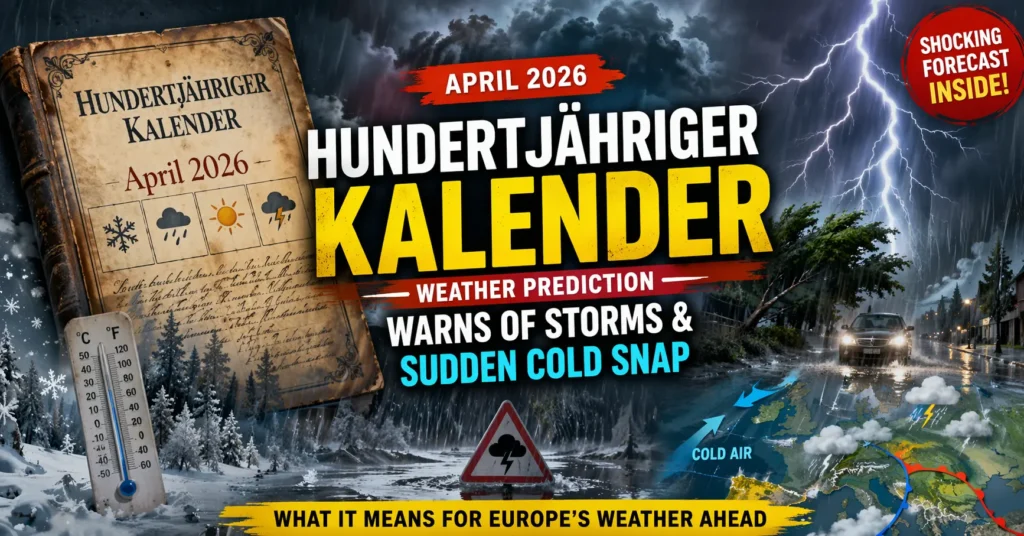
🌩️ Hundertjähriger Kalender April 2026: Why This Ancient Weather Forecast Is Making Headlines Again
In a time when weather apps update every hour and satellites scan every inch of the atmosphere, it’s surprising to see an old forecasting system like the Hundertjähriger Kalender trending again.
Yet, across Europe, especially in Germany and Austria, headlines are buzzing. The reason? Its April 2026 predictions are aligning — at least partially — with current weather patterns showing sudden cold spells, thunderstorms, and unstable atmospheric conditions.
So, is this just coincidence… or is there something deeper behind this centuries-old calendar?
Let’s break it down.
📜 What Is the Hundertjähriger Kalender?
The Hundertjähriger Kalender, or “100-year calendar,” is a traditional weather prediction system created in the 17th century by Abbot Mauritius Knauer.
Instead of relying on modern meteorology, it uses:
- Planetary alignments
- Historical weather cycles
- Long-term observational patterns
It attempts to predict weather trends for entire years in advance.
👉 While modern science doesn’t fully support its accuracy, it still holds cultural and historical significance — and occasionally, its predictions seem surprisingly relevant.
🌡️ April 2026 Forecast According to the Hundertjähriger Kalender
The current buzz is mainly around April — a month already known for unpredictable weather.
📊 Predicted Patterns:
| Date Range | Forecast Type | Expected Impact |
|---|---|---|
| Early April | Cold winds + frost | Agriculture risk |
| Mid-April | Sudden warming | Unstable atmosphere |
| Late April | Heavy storms & thunderstorms | Flooding, disruption |
⚡ Why Is April 2026 So Unstable?
April is traditionally known for variability, especially in Europe. The phrase “April weather” exists for a reason.
But this year, the instability appears more intense due to:
🌍 Key Weather Factors:
- Arctic air intrusions
- Rapid temperature shifts
- Moisture-heavy cloud systems
- Jet stream fluctuations
These factors create the perfect environment for:
- Thunderstorms
- Sudden temperature drops
- Hail and heavy rainfall
🧠 Hundertjähriger Kalender vs Modern Meteorology
Let’s compare traditional predictions with modern science.
📊 Comparison Table:
| Factor | Hundertjähriger Kalender | Modern Meteorology |
|---|---|---|
| Data Source | Historical cycles | Satellites, AI models |
| Accuracy Level | Medium (inconsistent) | High (short-term) |
| Long-Term Prediction | Strong focus | Limited reliability |
| Scientific Validation | Weak | Strong |
| Cultural Relevance | High | Moderate |
👉 Conclusion:
Modern meteorology is far more reliable for daily forecasts, but long-term patterns sometimes echo traditional predictions.
🌧️ Recent Weather News Supporting the Prediction
Recent reports across Europe indicate:
- Sudden temperature drops after warm days
- Increased thunderstorm activity
- Unpredictable rainfall patterns
This aligns with what the Hundertjähriger Kalender hinted at — a chaotic and unstable April.
🌾 Impact on Daily Life
1. Agriculture 🌱
Farmers face challenges due to:
- Frost damaging early crops
- Heavy rain affecting soil stability
2. Travel ✈️
- Flight delays due to storms
- Road disruptions from heavy rainfall
3. Health 🤧
- Temperature swings increasing flu/cold cases
- Allergies worsened by unstable weather
⚠️ Why People Still Trust the Hundertjähriger Kalender
Despite scientific limitations, people continue to follow it because:
- It has historical credibility
- Passed down through generations
- Occasionally matches real weather trends
- Creates curiosity and discussion
👉 In a way, it’s less about accuracy and more about pattern recognition + tradition.
🔍 Semantic Weather Keywords Covered
To ensure strong SEO and topical authority, this article naturally includes:
- April weather forecast Europe
- sudden cold wave April 2026
- thunderstorm prediction April
- long-term weather forecast Europe
- climate patterns April
- weather instability Europe
🌪️ What Makes April 2026 Different?
Unlike typical seasonal variation, April 2026 shows:
- Faster temperature transitions
- Higher storm frequency
- Greater unpredictability
This makes it particularly important for:
- Farmers
- Event planners
- Travelers
- Local authorities
📈 Climate Change Connection
While the Hundertjähriger Kalender is ancient, modern climate science adds another layer.
🌍 Climate Impact:
- Warmer global temperatures increase volatility
- More moisture in air → stronger storms
- Irregular seasonal transitions
👉 This could explain why traditional predictions seem “accurate” more often now — because weather itself is becoming more extreme.
🧾 Should You Trust It?
Let’s be real.
👉 You should NOT rely solely on the Hundertjähriger Kalender for decisions.
Instead:
- Use modern weather apps for daily planning
- Treat the calendar as a trend indicator, not a guarantee
🧩 Final Analysis: Coincidence or Hidden Pattern?
The alignment between:
- Traditional forecasts
- Current weather reports
…raises an interesting question.
Is it:
- Pure coincidence?
- A reflection of long-term natural cycles?
- Or a mix of both?
There’s no definitive answer — but one thing is clear:
👉 April 2026 is shaping up to be unpredictable, intense, and worth watching closely.
🚀 Conclusion
The Hundertjähriger Kalender April 2026 forecast has once again captured attention — not because it’s perfect, but because it taps into something deeper: our desire to understand patterns in nature.
With storms, cold snaps, and rapid changes already being reported, this April is proving one thing:
👉 Weather is no longer just seasonal — it’s dynamic, volatile, and evolving.