


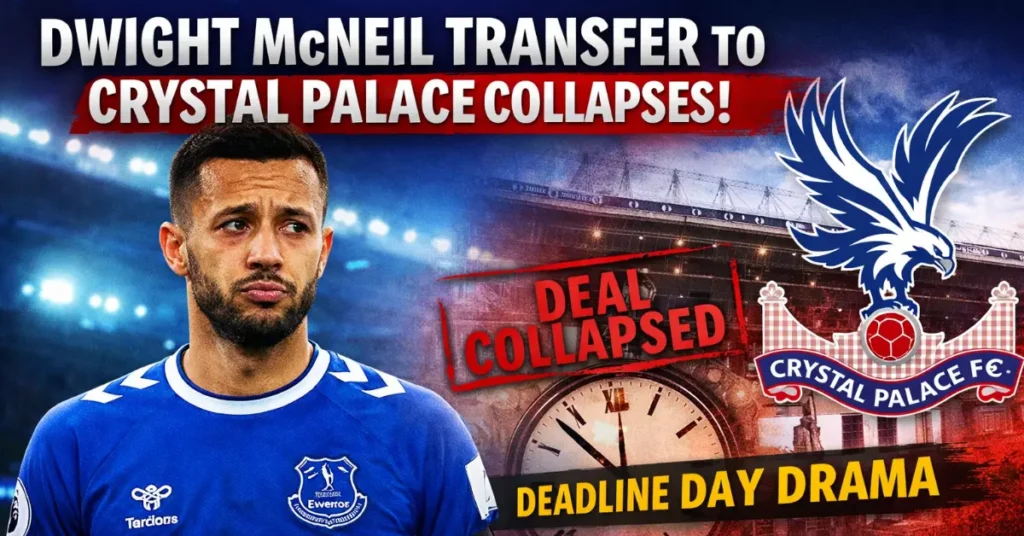
Introduction: A Transfer That Looked Done Until It Wasn’t
Football transfers rarely fail after a medical is completed. Even rarer are deals that collapse after both clubs agree a fee, a deal sheet is submitted, and the player is mentally prepared to move.
Yet, that is exactly what happened with Dwight McNeil’s proposed move from Everton to Crystal Palace during the January 2026 transfer deadline.
For several hours, the deal was considered “done.” Trusted journalists reported it. Club insiders confirmed it. Fans refreshed social media waiting for the announcement photo.
And then — silence.
By the end of deadline day, the transfer had collapsed entirely, leaving McNeil stuck in limbo, Everton frustrated, and Crystal Palace facing criticism from fans and pundits alike.
This article breaks down everything:
-
What really happened
-
Why the deal collapsed
-
Who was responsible
-
What it means for Dwight McNeil
-
How Everton and Palace are affected
-
And what comes next
This is not a quick news recap.
This is the full story, explained clearly, honestly, and in context.

Who Is Dwight McNeil? (Player Background & Profile)
Before understanding the transfer drama, it’s important to understand who Dwight McNeil is as a footballer.
Basic Profile
| Detail | Information |
|---|---|
| Full Name | Dwight James Matthew McNeil |
| Date of Birth | 22 November 1999 |
| Age | 26 |
| Nationality | English |
| Position | Left Winger / Attacking Midfielder |
| Strong Foot | Left |
| Current Club | Everton |
| Contract Until | 2027 |
McNeil is not a young prospect anymore — he is a Premier League-experienced winger entering his prime years.
Dwight McNeil’s Career Journey: From Burnley to Everton
Early Years & Burnley Breakthrough
Dwight McNeil rose to prominence at Burnley, where he became known for:
-
Excellent crossing ability
-
High work rate
-
Tactical discipline
-
Set-piece delivery
Despite playing in a defensively minded team, McNeil consistently created chances and became one of Burnley’s most reliable attacking outlets.
Move to Everton
In 2022, Everton signed McNeil for around £20 million, believing he could:
-
Add creativity
-
Improve chance creation
-
Bring Premier League reliability
And for a period, he delivered.
Dwight McNeil at Everton: Performance Analysis
Season-by-Season Overview
| Season | Appearances | Goals | Assists | Overall Impact |
|---|---|---|---|---|
| 2022-23 | 30+ | 7 | 6 | Strong adaptation |
| 2023-24 | 35+ | 5 | 8 | Creative leader |
| 2024-25 | 28 | 2 | 4 | Inconsistent |
| 2025-26 | 14 | 0 | 1 | Reduced role |
Why His Role Declined
-
Tactical changes at Everton
-
Increased competition on the wings
-
Preference for faster, more direct attackers
-
Confidence dips due to inconsistent starts
This context explains why Everton were open to selling — and why McNeil was open to leaving.
Why Crystal Palace Wanted Dwight McNeil
Crystal Palace’s interest in McNeil was not random.
Palace’s Tactical Needs
-
Lack of consistent creativity from wide areas
-
Over-reliance on individual moments
-
Need for Premier League-ready players
McNeil offered:
✔ Proven Premier League experience
✔ Tactical discipline
✔ Left-footed balance
✔ Immediate squad depth
On paper, it made sense.
Timeline: How the Transfer Unfolded (Hour by Hour)
24 Hours Before Deadline
-
Crystal Palace open formal talks with Everton
-
McNeil identified as priority target
16 Hours Before Deadline
-
Everton accept a deal worth around £20 million
-
Player given permission to travel
8 Hours Before Deadline
-
McNeil completes medical tests
-
Personal terms broadly agreed
Deadline Approaches
-
Palace submit a deal sheet before 7pm
-
This extends deadline to 9pm for paperwork
Final Hours
-
Palace attempt to restructure the deal
-
Everton refuse last-minute changes
-
Paperwork not completed
Result
❌ Transfer collapses
❌ McNeil remains at Everton
❌ Palace withdraw completely
What Is a Deal Sheet? (Important Explanation for New Fans)
A deal sheet is a document submitted to the Premier League that:
-
Confirms clubs have agreed a transfer
-
Requests extra time to finalize paperwork
-
Does not guarantee the transfer will complete
This is where many fans get confused.
Submitting a deal sheet means:
✅ Negotiations reached final stage
❌ Transfer is not legally completed
Crystal Palace used this mechanism — but failed to finish the process.
Why the Dwight McNeil Transfer Collapsed (Real Reasons)
This wasn’t one single mistake. It was a chain of failures.
1. Financial Restructuring Attempt
Palace reportedly tried to:
-
Change the deal from permanent to loan-with-obligation
-
Reduce upfront payment
Everton refused.
2. Internal Palace Issues
-
Palace were juggling multiple deals
-
Outgoing transfers failed
-
Squad balance concerns emerged
3. Time Mismanagement
Deadline day transfers require:
-
Perfect timing
-
Clear communication
-
Fast paperwork
Palace failed at this stage.
4. Everton Drew a Line
Everton had already agreed terms.
They were not willing to renegotiate under pressure.
Result: deal dead.
Impact on Dwight McNeil (Player Perspective)
This is the most overlooked part of the story.
Mental & Emotional Impact
-
McNeil had mentally prepared to move
-
Medical completed
-
Family expectations set
When a transfer collapses this late:
-
Confidence takes a hit
-
Trust in the process drops
-
Dressing room dynamics change
His partner reportedly expressed frustration publicly — highlighting the human cost of deadline-day chaos.
Impact on Everton
Short-Term
✔ Retain squad depth
✔ Avoid forced sale
Long-Term
❌ Player morale concerns
❌ Reduced resale value if minutes stay low
❌ Unclear role moving forward
Everton now must reintegrate a player who was halfway out the door.
Impact on Crystal Palace
Sporting Impact
-
Missed out on a needed winger
-
Squandered time on deadline day
-
Failed to strengthen depth adequately
Reputation Damage
-
Fans questioned club planning
-
Media criticism intensified
-
Trust in recruitment strategy weakened
Deadline day mistakes are remembered — especially when medicals are completed.
Statistical Comparison: McNeil vs Palace Wingers
| Player | Goals | Assists | Chances Created |
|---|---|---|---|
| Dwight McNeil | Moderate | High | Consistent |
| Palace Winger A | Inconsistent | Low | Low |
| Palace Winger B | Pace-based | Limited | Medium |
This comparison explains why Palace wanted him — and why missing out hurts.
Transfer Market Context: Why January Deals Fail More Often
January window problems:
-
Short planning time
-
Overpriced players
-
Panic decisions
-
Complex loan clauses
McNeil’s case fits the pattern perfectly.
Could the Transfer Happen Again in Summer?
Yes — and summer is actually more likely.
Why Summer Makes Sense
-
No deadline-day chaos
-
Clear squad planning
-
Better financial flexibility
-
Player fully prepared
However, Palace may no longer be first in line.
What’s Next for Dwight McNeil? (Possible Scenarios)
Scenario 1: Stay & Fight at Everton
-
Regain starting spot
-
Improve form
-
Restore market value
Scenario 2: Summer Transfer
-
Palace or another mid-table club
-
Possibly lower fee
Scenario 3: Loan Move
-
Short-term confidence rebuild
-
Prove fitness and form
Much depends on Everton’s tactical direction.
Why This Story Matters Beyond One Transfer
This isn’t just about Dwight McNeil.
It highlights:
-
How fragile deadline-day deals are
-
The human side of football business
-
The risks of last-minute negotiation tactics
-
Why clubs must respect players, not just contracts
For fans, it’s a reminder that transfers are not FIFA-style instant swaps — they are complex, emotional, and sometimes brutal.
Final Verdict: A Deal That Failed Everyone
The collapsed Dwight McNeil transfer to Crystal Palace is a textbook example of:
❌ Poor deadline-day execution
❌ Risky negotiation tactics
❌ Lack of contingency planning
Everton lost momentum.
Palace lost credibility.
McNeil lost clarity.
The only certainty is this:
The story isn’t finished yet.